
Anthropic Launches Claude Opus 4.7 (Best AI Model Yet)
Anthropic just released Claude Opus 4.7, the latest flagship model in the Claude family. The upgrade hits hardest in coding, vision, and long-running agentic tasks. Here is everything you need to know about what changed and why it matters.
What Is Claude Opus 4.7?
Claude Opus 4.7 is Anthropic's most capable model to date, launched on April 16, 2026. It replaces Opus 4.6 as the top-tier option across Claude.ai, the Claude API, Amazon Bedrock, Google Cloud Vertex AI, and Microsoft Foundry. The model ID is claude-opus-4-7.
The headline improvements land in three areas: software engineering consistency, visual understanding, and instruction following. Anthropic describes the model as showing "rigor and consistency" on complex assignments while "paying precise attention to instructions." Early testers back that up with specific numbers, which I will get to in a moment.
If you are already using Claude for coding or content work, this is the upgrade that makes agentic workflows feel production-ready rather than experimental. For context on how Claude fits into the broader AI model landscape, see my breakdown of Claude Mythos, the security-focused model Anthropic announced earlier this month.
Claude Opus 4.7 Benchmarks and Performance
The numbers tell the story better than any marketing copy. Here is where Opus 4.7 lands relative to its predecessor and the competition.
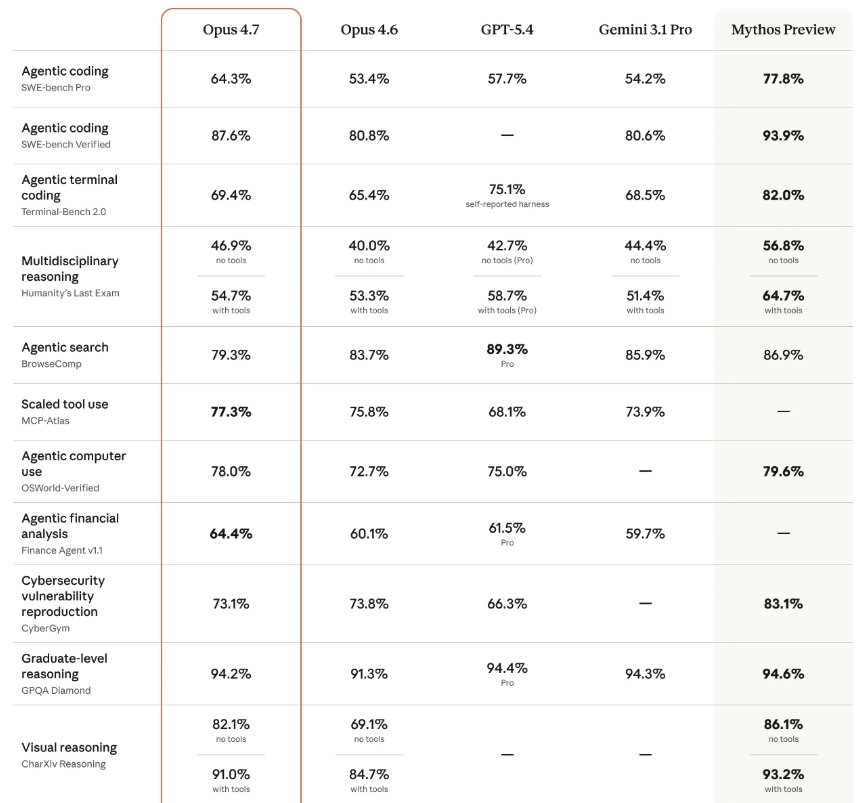
The full benchmark table paints the clearest picture. On SWE-bench Pro, Opus 4.7 hits 64.3% versus 53.4% for Opus 4.6 and 57.7% for GPT-5.4. SWE-bench Verified reaches 87.6% compared to 80.8% for Opus 4.6. Agentic terminal coding on Terminal Bench 2.0 lands at 69.4% versus 65.4% for the previous model.
Finance benchmarks hit state-of-the-art with 64.4% on Finance Agent v1, ahead of GPT-5.4 at 61.5%. Graduate-level reasoning on GPQA Diamond scores 82.1% versus 69.1% for Opus 4.6. Visual reasoning on ChartQA Reasoning reaches 91.0% compared to 84.7% for the previous version.
Agentic Coding Gets a Major Boost
One of the most practical improvements is how Opus 4.7 handles sustained coding tasks at different effort levels.
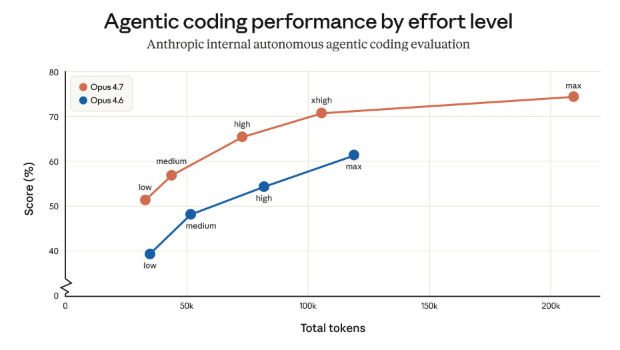
At every effort level, Opus 4.7 outperforms Opus 4.6. The new xhigh effort setting is the standout addition. It fills the gap between high and max, giving you finer control over how much compute the model spends on a given problem. At the xhigh level, Opus 4.7 scores around 71% compared to roughly 62% for Opus 4.6 at max effort, while using fewer tokens.
Devin's CEO said the model "works coherently for hours" and "pushes through hard problems rather than giving up." That tracks with what the effort-level chart shows. The model does not just perform better on easy tasks. It scales more efficiently as problems get harder.
Knowledge Work and Real-World Tasks
Beyond coding, Opus 4.7 sets a new bar for knowledge-intensive work.
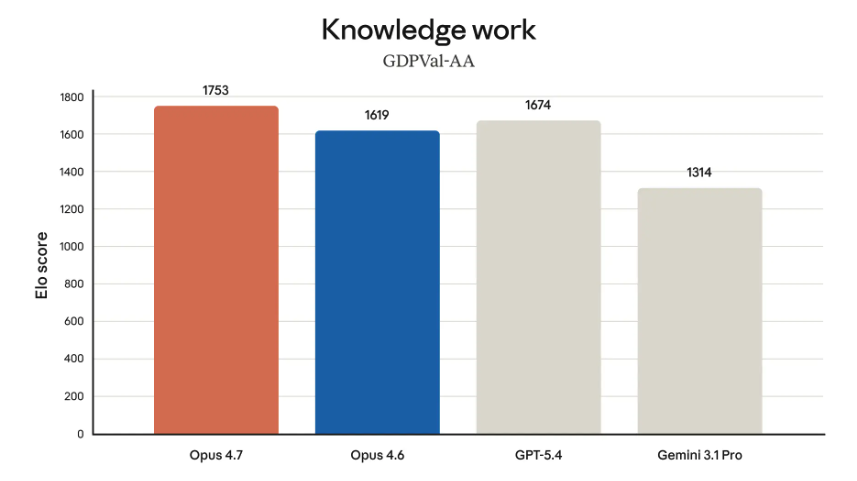
On the GDPVal-AA knowledge work benchmark, Opus 4.7 scores an Elo of 1753. GPT-5.4 comes in at 1674 and Opus 4.6 at 1619. Gemini 3.1 Pro trails at 1314. This benchmark measures real-world knowledge tasks, not synthetic puzzles, so the gap here matters for anyone using AI to research, analyze, or draft complex material.
Document reasoning improved by 21% fewer errors on enterprise document analysis. Notion's AI lead reported "+14% over Opus 4.6 at fewer tokens and a third of the tool errors." That combination of better results with lower cost and fewer failures is what makes this upgrade meaningful in production.
Multilingual and Multimodal Coding
Opus 4.7 expands beyond English-only coding benchmarks with strong multilingual and multimodal results.
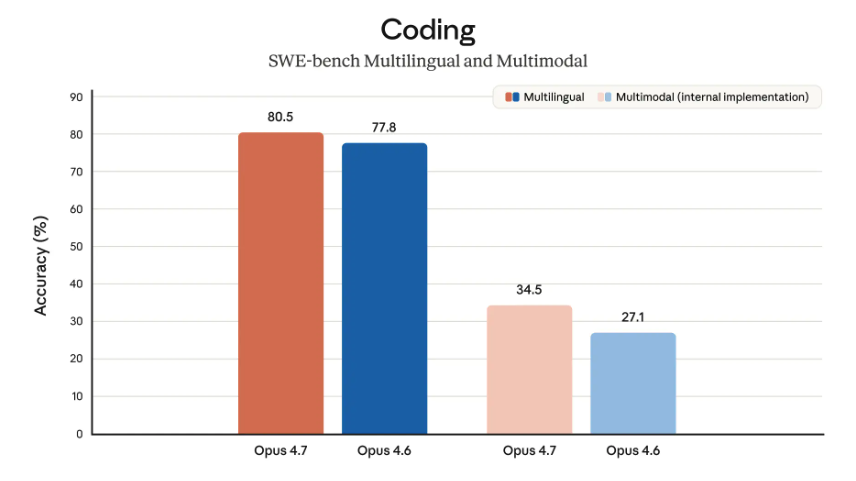
On SWE-bench Multilingual, Opus 4.7 reaches 80.5% accuracy versus 77.8% for Opus 4.6. The multimodal coding benchmark shows a bigger relative jump, from 27.1% to 34.5%. That 27% relative improvement on multimodal coding reflects the 3x vision resolution upgrade working its way into practical coding tasks where the model needs to interpret screenshots, diagrams, or UI mockups alongside code.
The vision upgrade processes images at up to 2,576 pixels on the long edge with roughly 3.75 megapixels of resolution. XBOW's CEO confirmed a 98.5% score on visual acuity benchmarks versus 54.5% for Opus 4.6. That is not incremental improvement. That is a generational leap.
Key Features and Improvements
Beyond raw benchmarks, several practical changes make Opus 4.7 feel different in daily use.
Better self-verification. The model checks its own work before reporting results. Stripe's VP of Technology noted the model "catches its own logical faults during planning" and "significantly accelerates execution."
Improved instruction following. Opus 4.7 takes instructions more literally than previous versions. Anthropic flags this as a potential adjustment point. If your prompts relied on the model inferring what you meant rather than following what you said, you may need to re-tune them.
File system memory. Multi-session work gets better with improved file-based memory. The model picks up context from previous sessions more reliably, which matters for long-running projects.
Task budgets. Now in public beta, task budgets let you set guardrails on how many tokens the model spends across a longer run. Useful for cost control on agentic coding tasks.
Ultrareview. A new slash command in Claude Code dedicated to bug detection. If you use Claude Code for development, this is worth testing on your next pull request. For more on how to get the most out of Claude in practice, check out my guide on why marketers should use Claude Code.
Safety and Alignment
Anthropic also shared safety evaluations for Opus 4.7, comparing it to previous models on misaligned behavior.
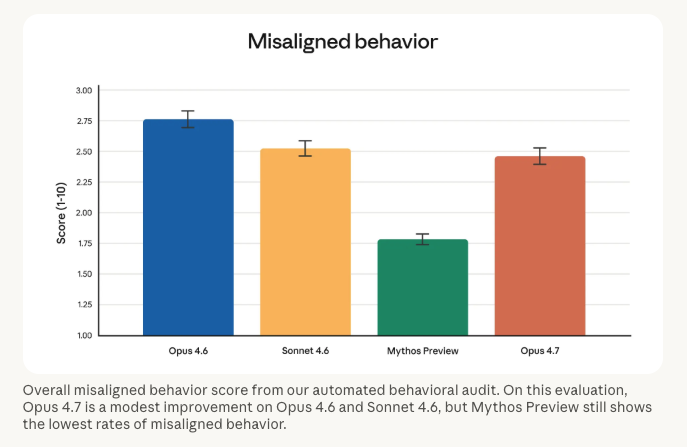
On Anthropic's automated behavioral audit, Opus 4.7 scores around 2.45 on a 1-10 misalignment scale, down from 2.75 for Opus 4.6. Sonnet 4.6 sits at roughly 2.5. Mythos Preview remains the most aligned model at approximately 1.78, but it is not publicly available.
The takeaway is that Opus 4.7 is modestly safer than its predecessor while being significantly more capable. Anthropic notes improved honesty and resistance to prompt injection attacks, though it is "largely well-aligned and trustworthy, though not fully ideal."
Pricing and Availability
Claude Opus 4.7 costs $5 per million input tokens and $25 per million output tokens, unchanged from Opus 4.6. It is available now on Claude.ai, the API, Amazon Bedrock, Google Cloud Vertex AI, and Microsoft Foundry.
One cost consideration worth flagging: Opus 4.7 uses an updated tokenizer, which means the same input may map to more tokens (roughly 1.0 to 1.35x depending on content type). The model also produces more output tokens at higher effort levels, especially in multi-turn agentic scenarios. Anthropic recommends using task budgets or adjusting effort levels to manage spend.
For the full technical breakdown and migration guidance, see the official Anthropic announcement.
My Honest Take on Claude Opus 4.7
I have been running Opus 4.7 since it dropped this morning, and the coding improvements are real. The model sticks with problems longer, verifies its own output, and follows instructions with less drift. The vision upgrade is the kind of jump that opens up use cases that were not practical before.
The tokenizer change is the one thing to watch. Same prompts, potentially higher costs. Anthropic says the net effect is positive on coding tasks because the model solves more problems per dollar, but your mileage will depend on your specific workload.
If you are already paying for Claude, there is no reason not to switch. If you are evaluating AI models for serious coding or content work, this is the new bar. The gap between Opus 4.7 and everything else just got wider.