
7 Best Postiz Alternatives in 2026 (Tested by an Agency Owner)
Most written guides to Postiz alternatives on page one come from companies selling one of the alternatives, which is why the same three tools keep winning. I take money from exactly one company on this list and I am telling you which one: Blotato is a client of mine and my #1 pick, so weigh that entry against the math rather than my word. I have no relationship with the other six.
Here is the part those vendor lists skip: leaving Postiz is often the wrong move.
Who I Am to Rank These
I run an agency and a content business. Publishing is a thing I do every week across my own channels and client accounts, not a category I write about from the outside.
Two limits on that, up front, because they change how you should read the rankings. I have run Postiz on their hosted cloud plan and I publish through Blotato most weeks. The rest I have set up and posted through rather than lived in for a year, which is enough to judge setup, pricing and what breaks early, and not enough to tell you how they behave at month eleven.
The bigger one: I have never self-hosted Postiz, or anything else. Where the self-hosted sections below make a claim, it comes from Postiz's own documentation or from what self-hosters report, and I say which. What I can speak to firsthand is the adjacent version of that work. I spent a long stretch running my publishing through n8n, rebuilding broken nodes and re-authing dead API keys, and that is the same hour of the week under a different name.
Pricing here was checked live on each vendor's own page, on the monthly toggle. That last detail matters more than it should. Most of these pages default to annual billing and print the annual rate with a "/month" label next to it.
Best Postiz Alternatives at a Glance
Six different billing units sit in this table. That is the actual difficulty of the comparison, and it is why "cheapest" depends entirely on how many accounts you connect.
| Tool | Best for | Starts at (monthly billing) | What you pay per | Who runs the server |
|---|---|---|---|---|
| Blotato | Creators who want an AI agent writing and publishing without a per-account bill | $29/mo flat | Plan, 20 accounts included | Blotato |
| Mixpost | Self-hosters whose objection is subscriptions, not server work | $299 one time (Pro) | License, paid once | You |
| Zernio | Anyone running under 10 accounts who wants a free tier that stays free | Free for 2, then $6/account | Connected account | Zernio |
| Buffer | Creators on 3 or 4 channels who want the thing to simply never break | Free, then $6/channel | Channel | Buffer |
| Upload-Post | Developers who need reach into Discord, Telegram and Reddit | $24/mo (Basic) | Profile, 5 included | Upload-Post |
| Post Bridge | A flat-priced agent on a handful of accounts, if 9 platforms are enough | $29/mo (Starter) | Plan, 5 accounts at $29 | Post Bridge |
| Staying self-hosted | Data residency rules, existing infrastructure, or a need to modify the code | $0 license, plus your hours | Hosting, plus maintenance time | You |
One column that used to belong here is gone. Every hosted tool on this list ships an MCP server now, so an AI agent can drive any of them, and that stopped being a reason to pick one.
One vendor is missing from that table on purpose. Ayrshare bills per customer profile rather than per plan or channel, which puts it in a different category and at a much higher floor, so I gave it a separate pricing teardown.
The Real Cost of Self-Hosting
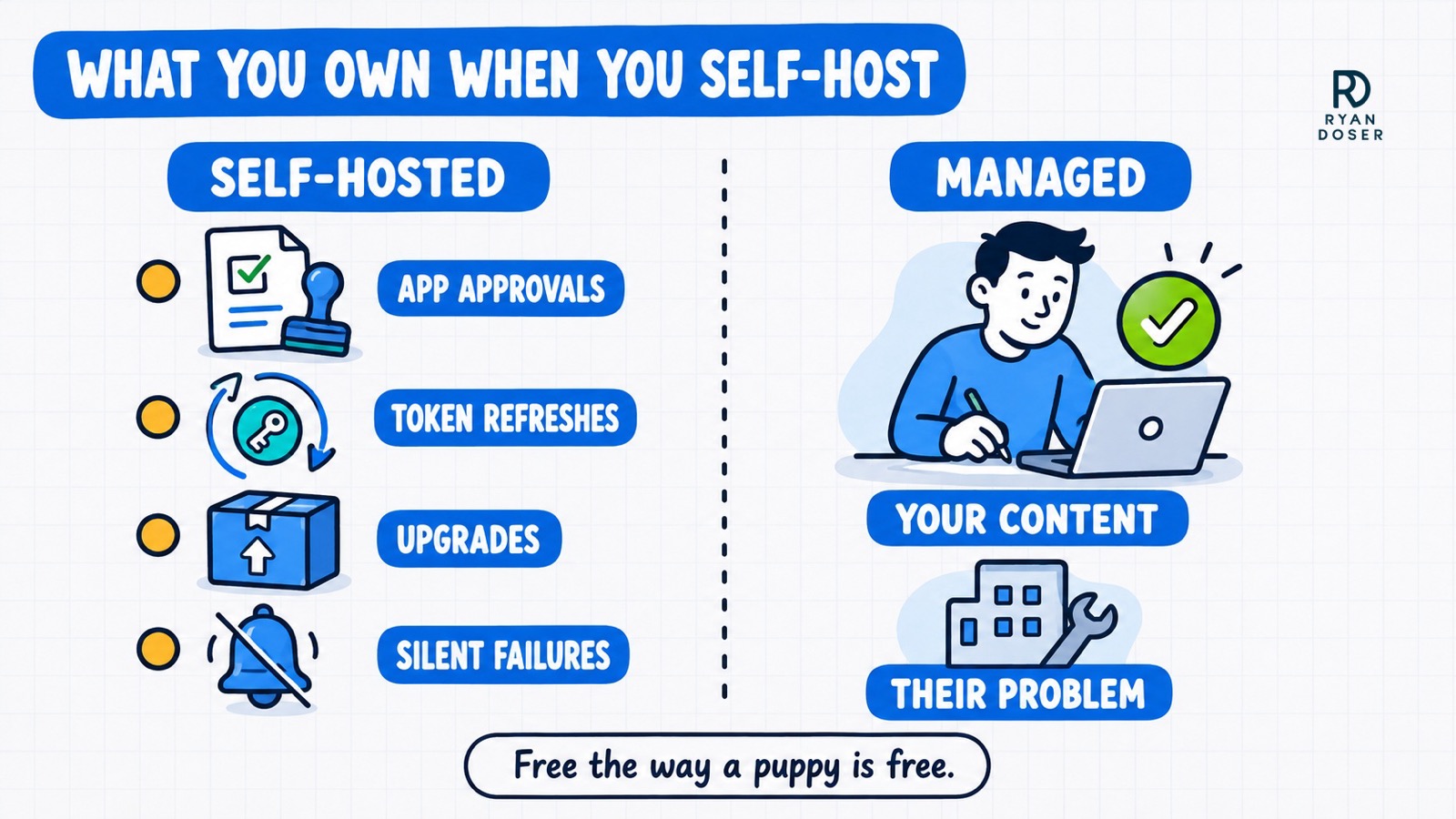
Self-hosting is free the way a puppy is free.
Per Postiz's documentation and the reports of people running it, here is what you take on. Platform app approvals, which you apply for yourself, per platform, under your own developer account. That is the part most people do not see coming.
Then OAuth token refreshes that break quietly, version upgrades that touch the database, server patching, and backups you have to test, because an untested backup is a rumor. Add uptime monitoring, because a scheduler that is down at 9am publishes nothing at 9am and does not tell you.
Now price your own hour. Two hours in a bad month, against a $29 cloud plan, means self-hosting pays only if your time is worth under $15 an hour.
The failure mode that actually hurts is not downtime. It is silent failure, and that part I have lived on managed tools rather than my own box. Social connections drop on their own, every scheduler I have used does it, and nothing announces it.
On a hosted tool you reconnect in the dashboard and move on. On your own box, that same silent failure is yours to detect, diagnose and fix, and you usually find out when someone asks why you went quiet for a week.
The 7 Best Postiz Alternatives
Ranked by who they actually fit, with the condition attached to each recommendation so you can tell in one line whether it is you.
1. Blotato (Best for an AI Agent Doing the Writing Too)

Affiliate and client relationship. Full disclosure here.
Blotato is the one I publish through most weeks, and its pitch against Postiz is not price, since both start at $29. It is that the $29 buys a different unit and includes the writing.
| Cost as you scale | What you pay |
|---|---|
| 5 accounts | $29/month |
| 20 accounts | $29/month |
| 21 accounts | $97/month, the next tier up |
| 40 accounts | $97/month |
| 100 accounts | $499/month |
| Cost per account at 20 | $1.45 |
| Cost per account at 5 | $5.80 |
Pros:
- Flat $29/month for 20 connected accounts, so the bill does not move as you add channels
- Writes the posts and generates images and video, which Postiz only partly does
- API and hosted MCP server included on the entry plan, not gated to a higher tier
Cons:
- No free tier at all, and generating an API key immediately ends the trial and starts billing
- Analytics covers 8 of the 9 platforms, with LinkedIn returning no metrics
- Comments and DMs reach Instagram and Facebook only
- It applies its own posting caps that are stricter than the platforms' own, including 25 Facebook posts per Page per day
Best for: Creators who want one flat bill covering 20 accounts and want the tool writing the drafts, not just queuing them.
Pricing: $29/mo Starter (20 accounts, 1,250 AI credits), $97 Creator (40 accounts), $499 Agency (100 accounts). Credits are spent only on AI image and video generation.
Free trial: 7 days on every plan, card required, and it excludes the API. If you came for the API, plan on starting the subscription rather than trialing it.
Bottom line: Count your networks first. Blotato earns the $29 when 9 platforms cover your stack and you want the drafts written for you, and it loses outright to Postiz the moment Mastodon or Discord is on your list.
2. Mixpost (Best for Owning It Without a Subscription)
Mixpost is the honest answer for the reader whose objection to Postiz is not the maintenance at all. Some people self-host because they refuse to rent software, and for them a monthly bill is the problem being solved.
| Break-even against a $29/month plan | Result |
|---|---|
| Months to recoup $299 | 11 |
| Year one total | $299 plus your hosting |
| Year two total | $0 plus hosting, if you skip renewing updates |
| Year three total | $0 plus hosting |
| A $29 plan over 3 years | $1,044 |
| Licensed domains | 1 per Pro license |
| Update window | 12 months, then optional |
Pros:
- One-time license instead of a recurring bill, so the cost stops after you pay it
- A free open-source Lite edition to try the model first
- No AGPL copyleft obligation, which matters if you plan to build on it commercially
Cons:
- Solves the subscription problem and does nothing at all about the maintenance problem
- Its MCP server runs on your own instance, so an agent can only reach it after you have stood up the server
- The Pro license covers one domain or subdomain, and updates are free for one year
Best for: Self-hosters who want ownership and accept the operational cost, not people trying to escape that cost.
Pricing: $299 one-time for Pro, $1,199 for Enterprise (white label and subscription management). A free Lite edition exists.
Free trial: No trial, but the open-source Lite edition is free to run indefinitely.
Bottom line: Buy Mixpost if renting software is the thing you object to. If your Saturdays are the thing you object to, this fixes nothing, and you should look at any hosted option on this list instead. The licensing contrast matters if you plan to build on either one commercially, and I worked through Postiz's AGPL terms in Postiz vs Blotato.
3. Zernio (Best If You Want the Free Feeling Without the Server)
Zernio is the closest thing here to keeping what you liked about self-hosting. You pay for exactly the accounts you connect, and at small scale that number is zero.
| Connected accounts | Monthly bill |
|---|---|
| 2 | $0 |
| 5 | $18 |
| 6 | $24 |
| 7 | $30, where a $29 flat plan overtakes it |
| 10 | $48 |
| 20 | $78 |
| 100 | $318 |
Pros:
- First 2 connected accounts are free with no credit card, and stay free
- Graduated pricing, so each tier's rate applies only to accounts inside that range
- Inbox and comments on every platform that has one, which is broader than most tools here manage
Cons:
- Per-account billing gets expensive fast in the middle band, where 20 accounts runs $78/month
- It does not write your content, so you bring the posts
- X analytics and inbox sync pass X's own per-call API charges straight through to you
Best for: Anyone running under 10 connected accounts who wants a real free tier rather than a countdown clock.
Pricing: Accounts 1-2 free, $6/month each for accounts 3-10, $3 for 11-100, $1 past that. Ten accounts works out to $48/month.
Free trial: Not a trial, an actual free tier. Two accounts, no card.
Bottom line: Zernio is the cheapest option here up to 6 connected accounts, where it runs $24 a month, and at 7 it hits $30 and a $29 flat plan has already passed it. I would read its comparison pages with some skepticism, and I wrote up why they need a second look.
4. Buffer (Best for Wanting a Scheduler That Never Breaks)
Buffer earns a spot because a real share of people who try self-hosting a scheduler just wanted a scheduler. If that describes you, the boring answer is the correct one.
| Channels | Essentials, billed monthly |
|---|---|
| 1 | $6 |
| 3 | $18 |
| 4 | $24 |
| 10 | $60 |
| 11 | $64, where the volume rate kicks in |
| 25 | $120 |
| 50 | $195 |
Pros:
- The most mature product in this roundup, with the fewest surprises
- A genuinely useful free plan: 3 channels, 10 scheduled posts each, plus one API key and 3,000 requests a month
- Per-channel rate drops with volume, reaching $4 per channel from 11 to 25
Cons:
- Per-channel billing punishes wide setups, since 10 channels is $60/month against Blotato's flat $29 for 20 accounts
- Reaches far fewer networks than Postiz does
- The pricing page defaults to the yearly toggle and prints the annual rate with a "/month" label, which is how nearly every comparison of Buffer gets it wrong
Best for: Creators on 3 or 4 channels who would rather stop optimizing and start posting.
Pricing: Free for 3 channels. Essentials is $6/channel/month ($5 on annual billing), Team is $12/channel/month ($10 annual).
Free trial: A permanent free plan rather than a trial, which is more useful than either.
Bottom line: At four channels Buffer costs $24/month and will not page you at 2am, and that is a good trade. Past ten channels the per-channel math turns against it and a flat plan wins, which I worked out at both account sizes in Blotato vs Buffer.
5. Upload-Post (Best for Reaching Networks the Big Tools Skip)
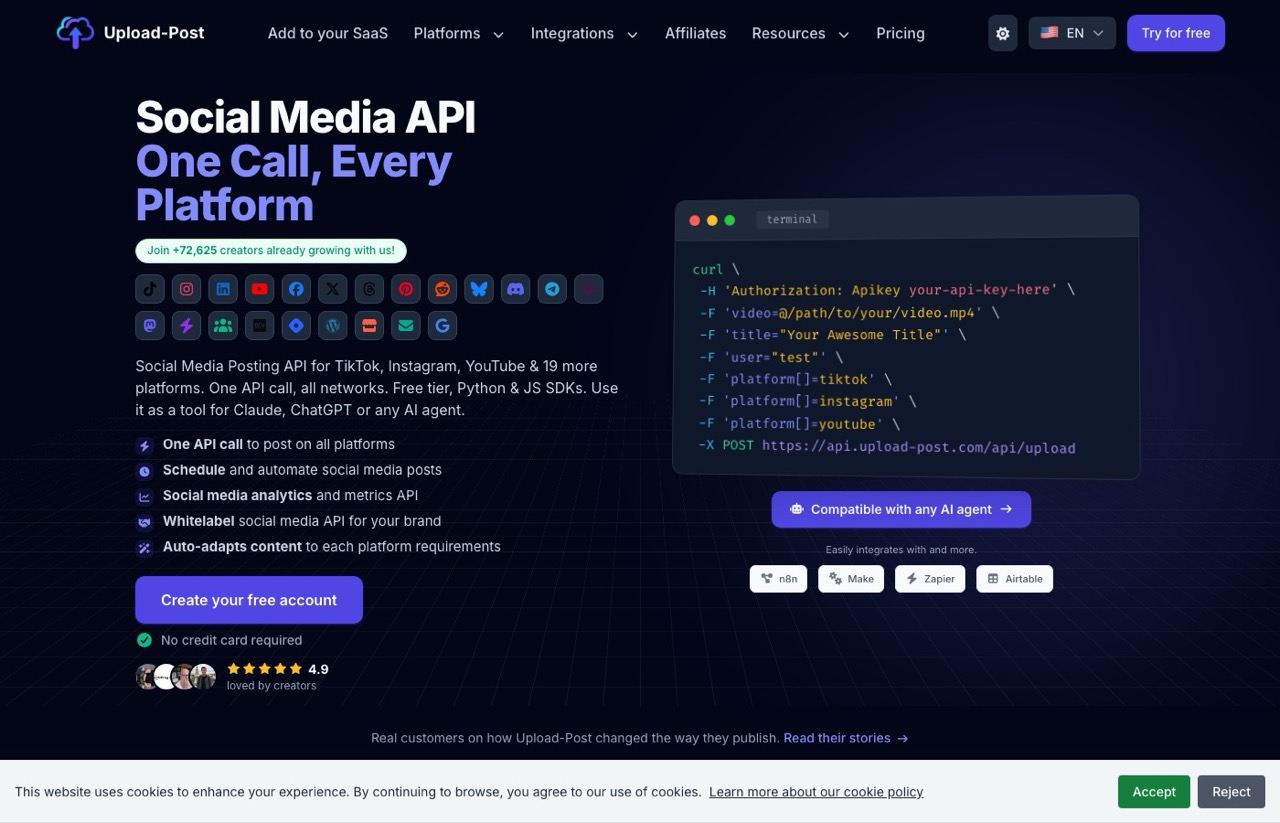
If part of why you picked Postiz was its reach into networks the mainstream tools ignore, Upload-Post is the hosted option that comes closest to matching it.
| Platform | Reachable on Upload-Post |
|---|---|
| Discord | Yes |
| Telegram | Yes |
| Yes | |
| Mastodon | Yes |
| WordPress | Yes |
| Dev.to and Hashnode | Yes |
| The mainstream nine | Yes, all of them |
Pros:
- 22 platforms including Discord, Telegram, Reddit, Mastodon and WordPress
- A real free tier with 2 profiles and 10 uploads a month, no card required
- Unlimited uploads on every paid plan, plus Python and JavaScript SDKs
Cons:
- Profiles, not accounts, are the unit, and the add-on packs do not stack
- Posting links on X is a separate $19/month add-on capped at 50 link-posts
- It publishes what you give it and does not write anything
Best for: Developers and agencies whose distribution list runs past the usual nine networks.
Pricing: Free for 2 profiles. Basic is $24/month for 5 profiles, Professional $50 for 25, Advanced $147 for 75. Annual billing cuts roughly a third on the lower two tiers.
Free trial: Yes, and the free tier is permanent rather than timed.
Bottom line: The 22-platform reach is the entire argument for Upload-Post, so it comes down to whether your distribution list actually uses it. Publishing only to the mainstream nine means paying for coverage that sits idle.
6. Post Bridge (Best for a Flat-Priced Agent on a Handful of Accounts)

Post Bridge aims at the same reader Postiz's agent positioning does, and it is the most direct head-to-head on this list. Earlier in 2026 it ran two different prices for the same product depending on which page you landed on. That is fixed. Both pages now open at $29, and the interesting question is no longer which page you read but how fast the account count runs out.
| Post Bridge tier | What it costs |
|---|---|
| Starter | $29/month, 5 accounts |
| Creator | $39/month, 15 accounts |
| Growth | $59/month, 50 accounts |
| Pro | $99/month, unlimited accounts |
| REST API add-on | +$5/month |
| Starter plus REST API | $34/month |
Pros:
- MCP access is included on every tier, starting at $29, with the REST API a $5 add-on on top
- The $99 Pro tier is unlimited connected accounts, which undercuts most per-account pricing at scale
- Ships an installable agent skill and a CLI, not only an MCP endpoint
Cons:
- Starter includes only 5 connected accounts, so the flat-rate advantage disappears the moment you pass a handful of profiles
- 9 platforms, so it does not solve the reach problem that sends people to Postiz
- Analytics is still labeled beta, and the API is an add-on rather than included
Best for: Someone running a small number of accounts who wants an agent posting through a real API and does not need more than 9 platforms.
Pricing: Starter $29 for 5 accounts, Creator $39 for 15, Growth $59 for 50, and Pro $99 for unlimited. MCP access is included from $29; the REST API is a $5 add-on on top of any tier, so Starter plus the API is $34. The agents page quotes the same $29 Starter the pricing page does.
Free trial: A 7-day trial with no charge due at signup.
Bottom line: Post Bridge is a clean flat-priced on-ramp to an agent that posts, as long as you count your accounts first. At 5 accounts it is $29 and at 50 it is $59, so the tier you actually land on matters more than the headline number.
7. Staying Self-Hosted (Best When Control Is the Actual Requirement)
Leaving is not automatically the right answer, and a list that never says so is a sales page. Three cases where I would tell you to stay put.
Stay if data residency is a requirement rather than a preference, because a client contract or a regulation says so. No managed tool on this list solves that for you.
Stay if you already run infrastructure. With a cluster, monitoring, and a backup routine you actually test, Postiz is one more small service on a system you maintain anyway, and the marginal cost really is near zero.
Stay if you need to modify the tool. Open source means you can change behavior, and no hosted API will ever match that.
Leave if publishing is a means to an end for your business rather than the business itself. Every hour spent on your scheduler is an hour not spent on the content going through it.
How to Choose Between These Postiz Alternatives
The same questions I work through on a client build, in the order I ask them.
- How many accounts will you connect twelve months from now? Under 10 favors per-account pricing. Over 15 favors flat.
- Do you need a network outside the mainstream nine? Discord, Telegram, Mastodon and Reddit narrow the field to two options fast.
- Are you buying a publisher or a writer? Most of these queue content you already made. One of them makes it.
- Is your objection the subscription or the maintenance? They point at opposite answers, and conflating them is the most common mistake I see.
- Does anything legal or contractual dictate where the data sits? If yes, this decision was already made for you.
Two more things worth knowing before you commit. Every hosted tool here ships an MCP server, so agent compatibility is no longer a tiebreaker, and I would not let a vendor sell it to you as one. And check whether API access is included at the tier you are actually buying, because it is gated differently on nearly every one of these.
Which One Should You Pick?
Under 10 accounts and cost-sensitive: Zernio, free for the first two.
Three or four channels and tired of fiddling: Buffer.
Want the tool writing the posts: Blotato at $29 flat.
Publishing to Discord or Telegram: Upload-Post.
Refuse to rent software: Mixpost, once, and keep the server.
A flat-priced agent that posts on 9 platforms without per-account math: Post Bridge at $29.
Bound by data residency or already running infrastructure: stay where you are.
What About Publer, Metricool and Hootsuite?
They show up on most lists in this category and they are not ranked here, which is deliberate. I have not set them up and posted through them the way I did with the seven above, and ranking software I have not touched is the exact thing that makes vendor roundups worthless.
Publer is the one I would look at first on price, at $5 for the first account and $4 for each additional on Professional. Metricool is the analytics-led pick and I compared it against my own stack in Blotato vs Metricool. Hootsuite is the enterprise option, and its entry price is multiples of everything above.
Any of the three could be right for you. I just have not earned the right to rank them.
Ryan's Final Thoughts
The self-hosting decision is not about money, and pretending otherwise is why people end up unhappy with whatever they choose. It is about which failures you want to own.
Run it yourself and you own uptime, approvals, upgrades and silent failures, in exchange for control and a $0 line item. Pay someone and you own a subscription, in exchange for someone else waking up when OAuth breaks.
My rule is to self-host the things where control is the point and pay for the things where reliability is the point. Publishing is a reliability job for me, so I pay. If you already run servers well, Postiz is excellent and the people running it happily are not wrong.
Postiz Alternatives FAQs
What is the best free Postiz alternative?
Zernio, if you connect two accounts or fewer, since its first two are free with no card and no time limit. Buffer's free plan covers 3 channels with 10 scheduled posts each plus API access. Upload-Post gives you 2 profiles and 10 uploads a month. All three are permanent free tiers rather than trials that expire.
Is there an open-source alternative to Postiz?
Mixpost is the main one. It is self-hosted and open source, with a free Lite edition limited to a few networks and a $299 one-time Pro license. Unlike Postiz it carries no AGPL copyleft obligation, which matters if you intend to build a commercial product on top of it.
Is Postiz really free?
The software is free and open source if you run it on your own infrastructure. You then absorb hosting costs, platform app approvals, upgrades, monitoring and backups. Postiz also sells hosted plans from $29/month for 5 channels if you would rather not run it yourself.
Why do people stop self-hosting their social scheduler?
Maintenance, not price. Platform app approvals, OAuth tokens expiring, upgrades that touch the database, and publishing failures that happen silently. The subscription you avoided is usually cheaper than the hours you spend once you price your own time honestly.
Does self-hosting Postiz get around platform API approvals?
No, and this surprises people. When you self-host you apply for each platform's API access yourself, per platform, under your own developer account. Managed services have already done that work, and it is a large part of what you are paying them for.
Which Postiz alternatives work with AI agents?
All of them. Blotato, Zernio, Upload-Post, Buffer and Post Bridge each run a hosted MCP server that Claude Code, Codex and similar agents can call. Mixpost's runs on your own instance instead, so an agent can only reach it once you have stood up the server. Compare what sits behind the server rather than its presence: account limits, platform coverage, and whether API access is included at your tier.
Disclosure: some links in this post are affiliate links, specifically Blotato. If you buy through them I may earn a commission at no extra cost to you. Blotato is also a client of mine and my account there is comped rather than paid. I have no relationship with Postiz, Zernio, Upload-Post, Mixpost, Buffer, Post Bridge, Publer, Metricool or Hootsuite. I only recommend tools I actually use. Full disclosure.