
7 Best AI Automation Tools in 2026 (Tested by a Founder)
The best AI automation tools in 2026 are the ones that actually run your work while you sleep. I run SEO and content systems for a seven-figure SaaS, a cybersecurity brand, and affiliate clients, and I have automations firing in the background across all of them right now.
I am not an engineer. I am a marketer who learned these tools the hard way, by wiring them up for real client work and eating the bill when I got it wrong. So this list is written for people like me: creators, solopreneurs, and lean teams who want automation that works without a computer-science degree. If you are shopping for enterprise RPA (UiPath, Microsoft Power Automate, Workato), this is not that list, and I will point you there at the end.
Why Most "Best AI Automation Tools" Lists Are Useless
Start with the dirty secret about this keyword. The top two results for it are published by two of the tools being ranked. Zapier's roundup concludes you should use Zapier. n8n's roundup concludes n8n is the best pick. You can smell the thumb on the scale.
I do not sell any of these tools. I use them, break them, and pay for them with my own money. So this list ranks by what happens when real work hits the platform, not by who has the biggest ad budget. I took the same no-spin approach with the best AI writing tools, where most of the market turns out to be wrappers reselling the same models.
One more thing the other lists miss. Automation is splitting into two camps. The classic no-code builders (Zapier, Make, n8n) still run most of the world's workflows, following a rigid if-this-then-that chain you map out in advance. If the specific job you are automating is social publishing, I worked through why per-task billing is the wrong shape for that separately. The new camp is AI-agent-native automation, where a model like Claude reads the situation and decides what to do instead of following a fixed script. The old way follows your rules. The new way makes its own calls. I cover both, because your stack in 2026 probably needs one of each.
AI Automation Tools at a Glance
| Tool | Best for | Starts at | Self-host | AI-agent-native |
|---|---|---|---|---|
| n8n | Self-hosting + high-volume AI work | Free (self-host) / $20/mo cloud | Yes | Yes |
| Make | Visual builders who want power | $12/mo | No | Partial |
| Zapier | Beginners + widest app coverage | $19.99/mo | No | Partial |
| Claude Code | Agent-native reasoning, not rigid steps | Pro/Max plan | No | Yes |
| Gumloop | AI-first no-code building | $37/mo | No | Yes |
| Lindy | Standing up an "AI employee" | $49.99/mo | No | Yes |
| Relay.app | Human-in-the-loop approvals | $19/mo | No | Yes |
The 7 Best AI Automation Tools in 2026
Every pick below gets the same treatment: pros, cons, who it fits, real pricing, and what the community actually says once the trial ends.
1. n8n (Best for Self-Hosting and High-Volume AI Workflows)
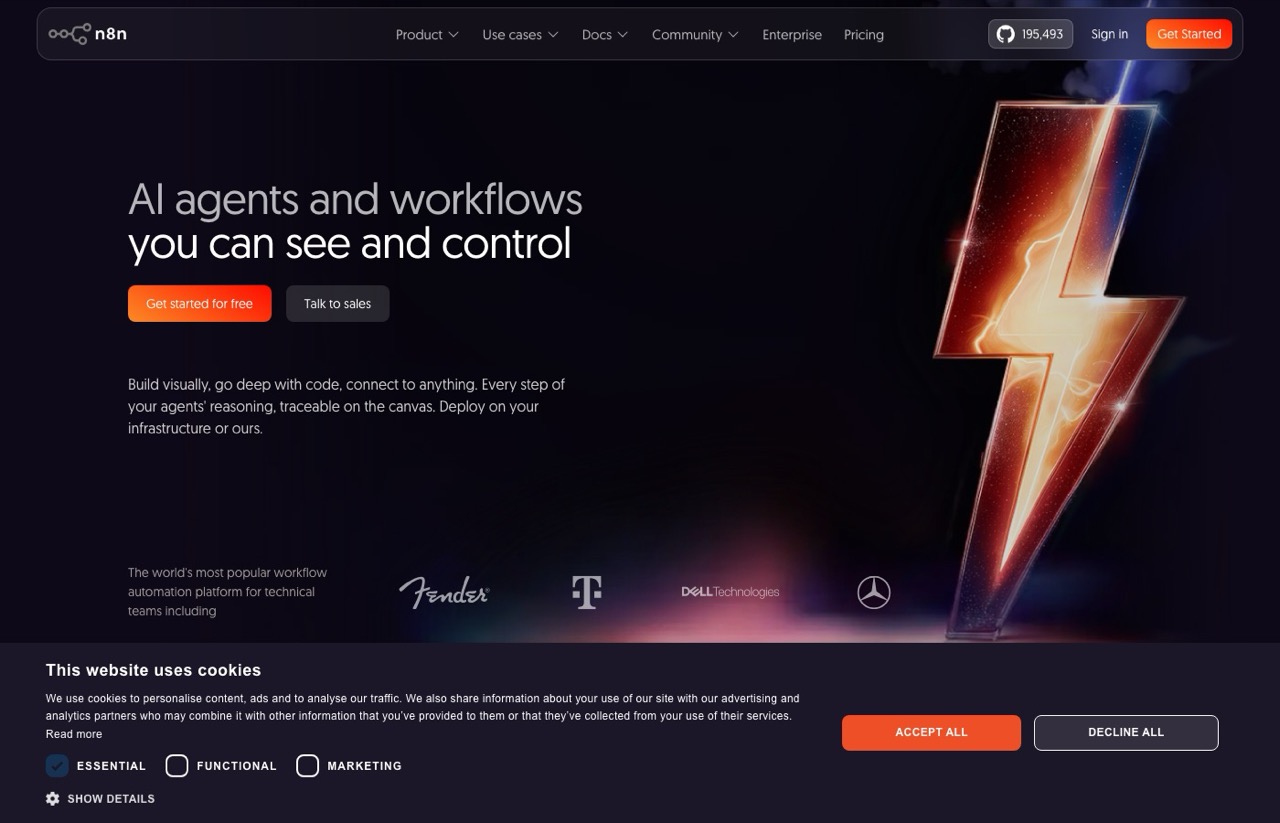
When a client's data cannot leave their own servers, I reach for n8n. It is source-available, self-hostable, and built with native AI-agent nodes, so you can run multi-step LLM workflows without paying a toll on every action.
Pros:
- Self-host the Community Edition for free with no per-run execution limits.
- Native AI-agent nodes for real multi-step LLM workflows.
- The go-to recommendation on Hacker News over Make, Zapier, and Pipedream for high-volume work.
Cons:
- The steepest learning curve of any tool here.
- Paid cloud and Business tiers draw pricing complaints (more below).
Best for: self-hosters, developers, and anyone doing high-volume AI work.
Pricing: Community Edition free to self-host. Cloud Starter is $20 per month billed annually for 2,500 workflow executions, and Pro is $50 for 10,000. Business runs $800 for 40,000 and is listed as a self-hosted plan rather than a hosted one. Every tier meters executions rather than active workflows, and steps inside an execution are unlimited.
Free trial: Yes, plus a genuinely free self-hosted edition.
Bottom line: If you can self-host, n8n is the cheapest and most private option on this list, and nothing else comes close on high-volume AI work.
The recurring gripe is cloud pricing. n8n's own community forum has a long, heated thread about the paid tiers' execution ceilings, with users frustrated that even a pricey plan on their own compute still meters them. If you self-host the free edition, none of that touches you, which is the whole point.
n8n raised a $180M round in late 2025 and took a strategic investment from SAP in 2026, so it is not going anywhere. If you want the deeper argument for why this platform is winning, I wrote a whole piece on whether n8n is dead or dominating.
2. Make (Best Value for Visual Builders)
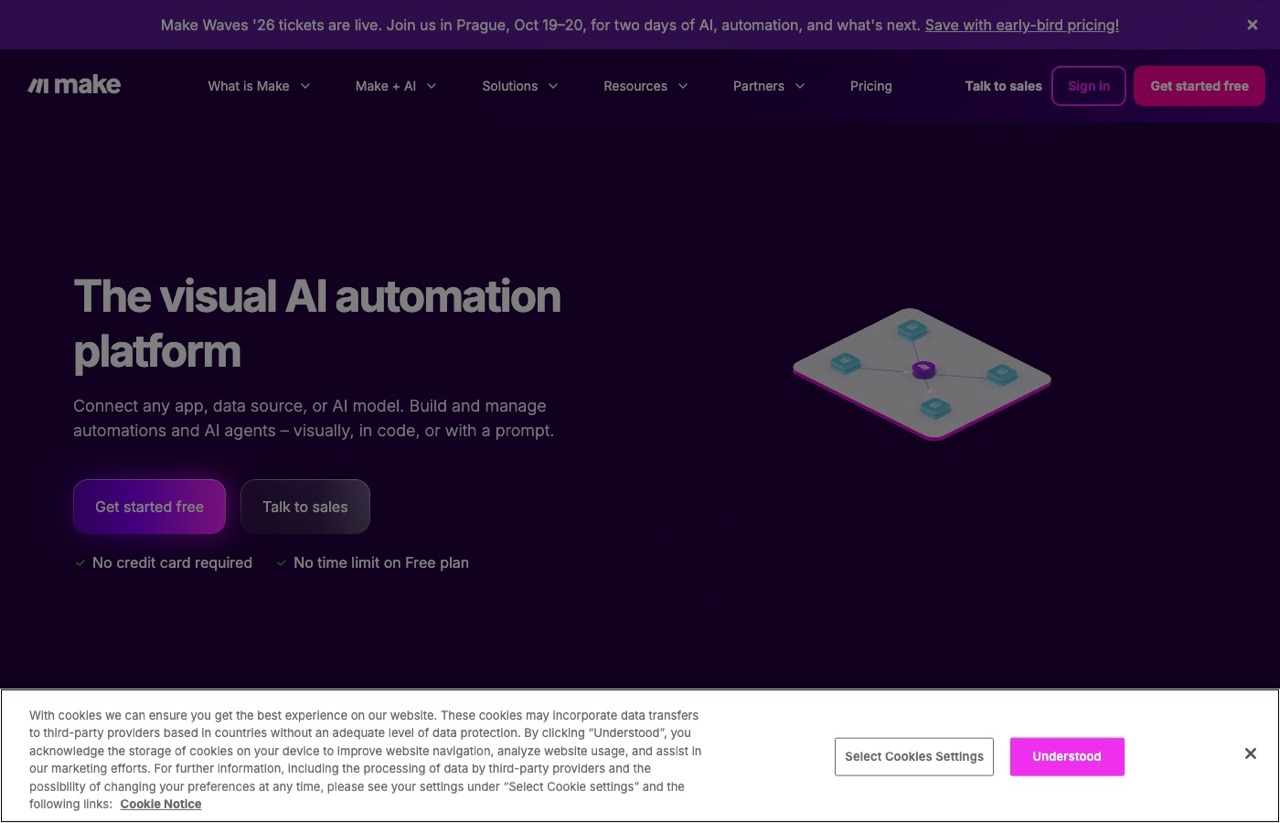
Hand Make to a marketer who wants real branching logic without touching code, and they will build something useful the same day. Its scenario canvas lets you create loops, filters, and multi-path automations visually, and it runs genuinely cheaper than Zapier at volume.
Pros:
- Node-based canvas that HN builders rate as more powerful than Zapier's linear steps.
- Real branching, loops, and filters without code.
- Cheaper than Zapier once your volume climbs.
Cons:
- Every module burns a credit, including triggers and filters Zapier runs for free.
- Auto-purchase of extra credits can produce surprise costs.
- A single error can halt every future run if you do not build error branches.
Best for: non-developers who want visual power on a budget.
Pricing: Free tier of 1,000 credits per month. Core starts at $12 per month. Each module action counts as one credit, so complex scenarios burn faster than you expect.
Free trial: Yes, a free tier you can stay on.
Bottom line: The best value for anyone who wants visual power and real logic without paying Zapier's premium, as long as you watch your credit burn.
One warning worth repeating. One user on Make's own community forum documented how a sequential-processing setup meant a single error halted every future run until he fixed it. Build with error branches from day one.
3. Zapier (Best for Beginners and App Coverage)
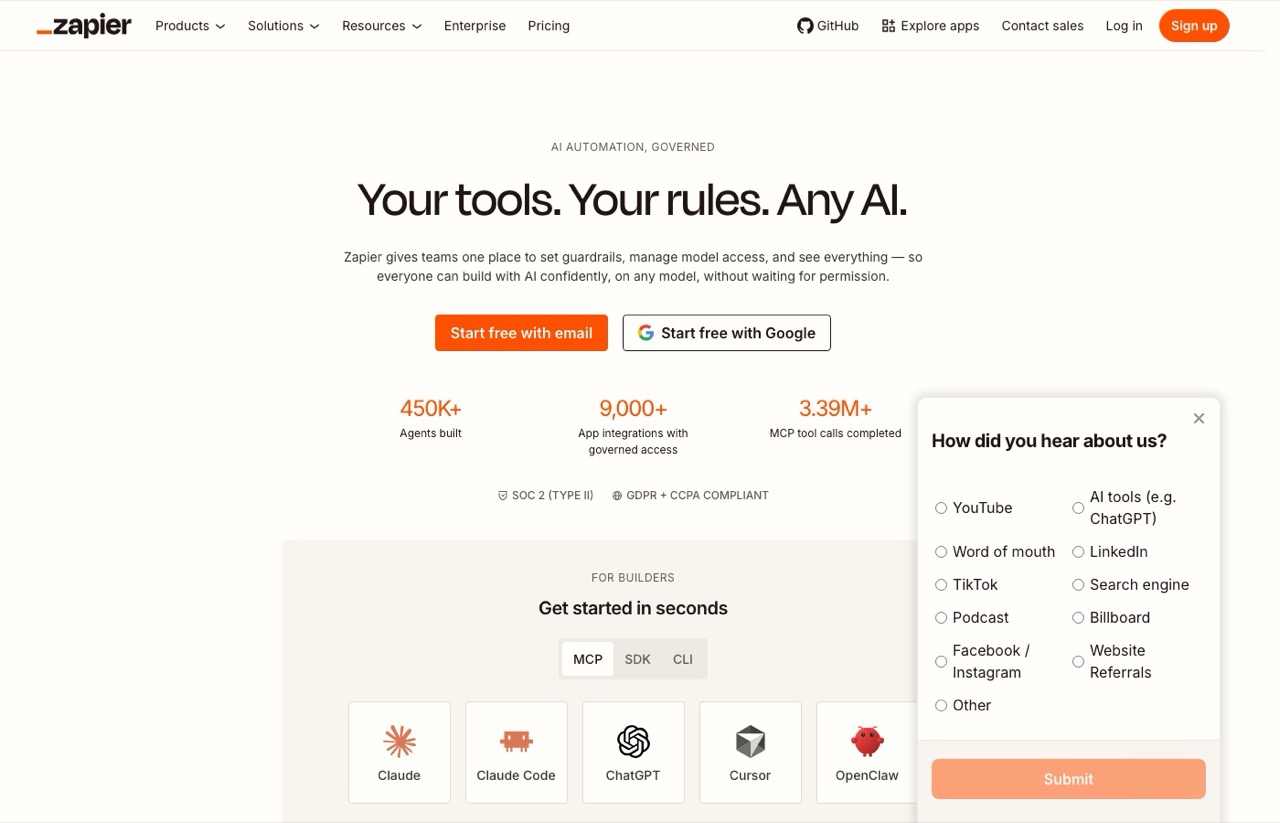
For someone who has never automated anything, Zapier is still my recommendation. Nothing else touches its app catalog, and its Copilot lets you describe a workflow in plain English and get a working Zap back.
Pros:
- The widest integration catalog of any tool here, by a mile.
- Copilot builds a working Zap from a plain-English description.
- Rock-solid reliability that kept it the default for a decade.
Cons:
- Gets brutally expensive at scale, since retries and loops each burn a task.
- AI Agents are priced separately from your main plan.
- AI-heavy Zaps eat tasks faster thanks to mid-2026 model-tier multipliers.
Best for: total beginners and anyone who needs the widest integration list.
Pricing: Free tier of 100 tasks per month. Professional starts at $19.99 per month billed annually ($29.99 monthly), priced up through fixed task tiers as your volume grows. AI steps now carry model-based multipliers, so an AI-heavy Zap costs more than a plain one.
Free trial: Yes, a permanent free tier.
Bottom line: Still the best place to learn automation and the safest bet for app coverage, but budget carefully before you scale.
The pain is the bill. Builders regularly report monthly invoices running into the hundreds once retries and loop iterations pile up, because each one burns a task. Zapier has pivoted hard toward AI, but the market perception is that n8n and the agent-native tools moved quicker, and n8n has overtaken it on search interest.
4. Claude Code (Best for AI-Agent-Native Automation)
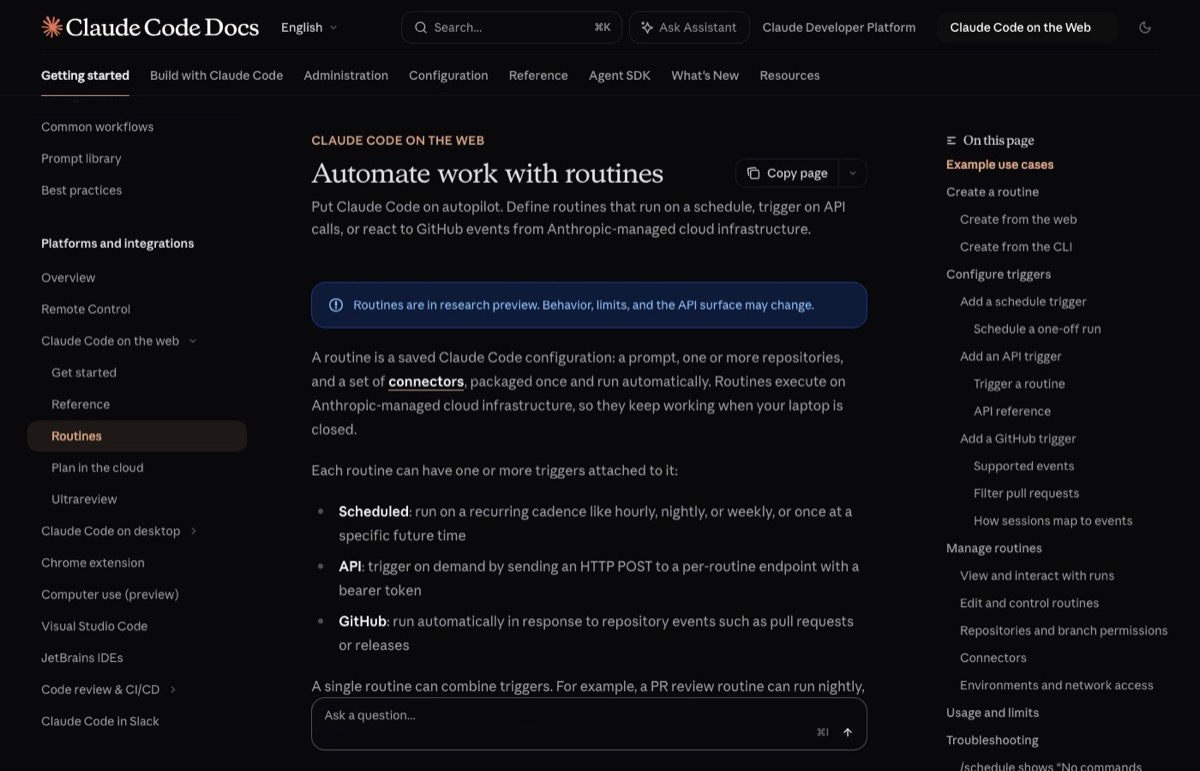
This is the pick no other roundup makes, and it is the one my readers should watch closest. For the social-specific side of this, see my breakdown of publishing and scheduling tools. Claude Code has grown past being a coding tool. With Routines and scheduled tasks, it runs prompts on a schedule, on an API call, or on a GitHub event, with Claude doing the actual reasoning.
Pros:
- A model reasons through the task instead of following a rigid flowchart.
- Triggers on a schedule, an API call, or a GitHub event.
- Closer to hiring a junior operator than wiring a diagram.
Cons:
- Non-determinism makes it risky for correctness-critical jobs.
- In routine mode, connected tools including writes run without asking permission.
- No free tier, so it needs a paid Claude plan.
Best for: builders who want a model, not a rigid workflow, doing the thinking.
Pricing: No standalone free tier. Included with a paid Claude Pro or Max plan. Routines run on Anthropic's cloud.
Free trial: No, it runs on a paid Claude plan.
Bottom line: The pick that ages best for reasoning-heavy work, as long as you keep it away from jobs where one wrong number is a disaster.
The difference is real. A Zap follows fixed steps. A Claude Routine reads the situation and decides what to do: groom your issue tracker every weeknight, triage an alert your monitoring tool POSTs to its endpoint, or run a weekly research sweep and open a draft.
The catch is real too, and the community says so plainly. On Hacker News, developers point out that the same non-determinism that makes Claude flexible also makes it unpredictable. It can hallucinate, and in routine mode all connected tools including writes are allowed, so an agent can go off-script. One finance user said constant double-counting made it worthless for numbers he could not re-check. Use Claude Code automation for reasoning-heavy, review-friendly work. If you are new to it, start with why marketers should use Claude Code before you wire up a Routine.
5. Gumloop (Best AI-First No-Code Builder)
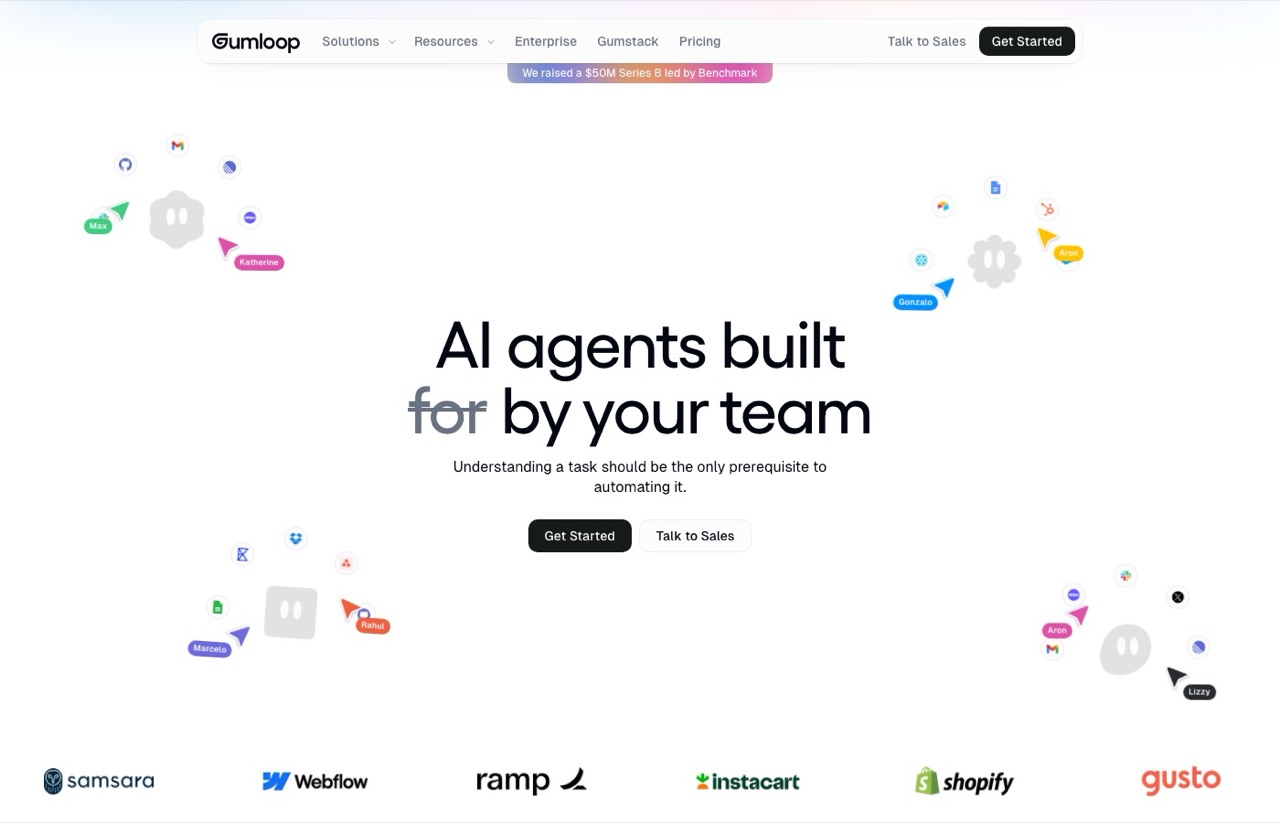
Gumloop feels like Zapier rebuilt from scratch around a model instead of bolting AI on afterward. It is a visual, no-code canvas built AI-first, so the automation and the reasoning live in the same place.
Pros:
- Built AI-first, so reasoning and automation live on the same canvas.
- Model-agnostic routing and reusable Subflows few competitors match.
- Marketers rate the build experience above most no-code AI tools.
Cons:
- Credit consumption is hard to predict.
- A small change can jump a workflow from a couple of credits to dozens.
Best for: teams that want an AI-native visual builder.
Pricing: Free tier of 5,000 credits per month. Pro starts at $37 per month.
Free trial: Yes, a free tier with monthly credits.
Bottom line: The strongest AI-first builder here, backed by a $50M Benchmark round, as long as you test credit burn before you scale.
Investors agree. Gumloop raised a $50M round led by Benchmark in early 2026.
6. Lindy (Best for Building an AI Employee)

Lindy is less a workflow builder and more an AI teammate. You describe the job in plain language, connect your inbox, calendar, and CRM, and it acts: drafting replies, booking meetings, and handling follow-ups without you mapping a single node.
Pros:
- Non-technical operators stand up a useful assistant in an afternoon.
- Tight Google, HubSpot, and Slack integration.
- A big template library to start from.
Cons:
- The credit system is the most-complained-about thing about it.
- A single voice call can burn hundreds of credits.
- Users report billing complaints, including charges after cancellation.
Best for: people who want an AI employee, not a flowchart.
Pricing: No free tier, just a 7-day trial. Plus starts at $49.99 per month.
Free trial: Yes, 7 days, no permanent free tier.
Bottom line: The fastest way to a working AI assistant, but watch the meter closely and cancel cleanly if you stop.
7. Relay.app (Best for Human-in-the-Loop AI)
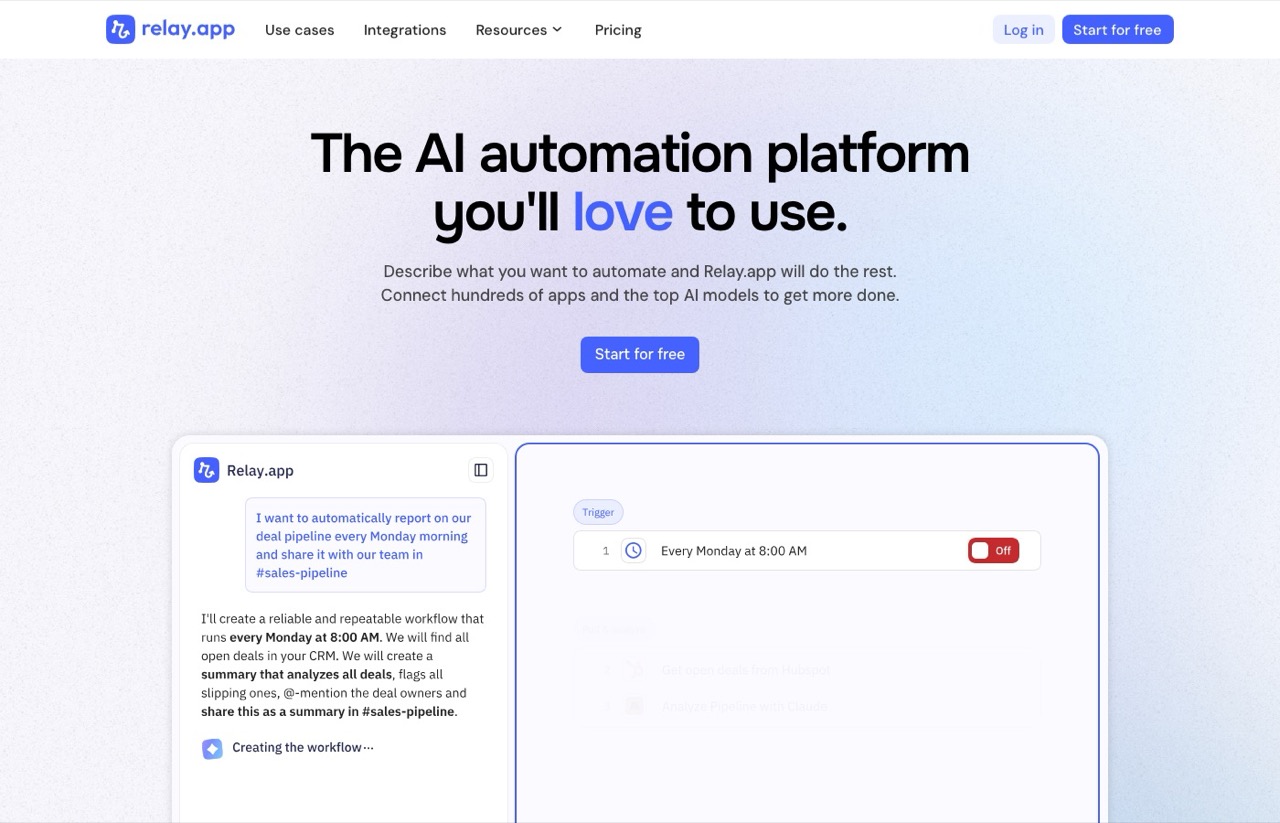
Relay.app solves the one thing that scares people about AI automation: letting a model send something without a human seeing it first. Its whole engine is built around approval checkpoints, so an automation can pause, wait for you to edit or approve, then continue.
Pros:
- The strongest human-in-the-loop approval steps in the group.
- 4.9 out of 5 across dozens of G2 reviews.
- Perfect for automations that draft client emails or social posts.
Cons:
- 200+ integrations, far fewer than Zapier or Make.
- A niche app you rely on may not be supported yet.
Best for: teams that need a human approval step inside AI workflows.
Pricing: Free tier of 500 AI credits and 200 steps per month. Professional starts at $19 per month billed annually.
Free trial: Yes, a free tier with monthly credits.
Bottom line: The safest way to put AI in front of your audience, as long as your must-have apps are among its 200-plus connectors.
Honorable Mentions (Community Darlings the Big Lists Skip)
These are the tools people who live in this space keep recommending, even though generic roundups bury them.
- Activepieces: the open-source, self-hostable escape hatch from per-task billing. MIT-licensed with 700+ integrations, free to self-host, paid cloud from around $5 per active flow. See Activepieces.
- Pipedream: developer-first, with real code steps in Node, Python, Go, and Bash, and a generous free tier. Loved for internal tools and side projects, though costs climb past the free plan. See Pipedream.
- Bardeen: Zapier for your browser. One-click no-code scraping and lead enrichment right in Chrome, with a free tier and paid plans from $10 per month. It stops when Chrome closes, so it fits GTM tasks more than always-on pipelines. See Bardeen.
How to Choose an AI Automation Tool
Before you commit to any platform, run your use case through these five questions. They are the same ones I ask on every client build.
- Does your data need to stay private? If a client's data cannot leave their servers, you need self-hosting, which narrows you to n8n or Activepieces fast.
- How much do you plan to run? Low volume favors Zapier's simplicity. High volume favors n8n's per-execution or self-hosted pricing before the bill gets scary.
- Do you want rules or reasoning? A fixed if-this-then-that chain (Zapier, Make) is predictable. An agent that makes its own calls (Claude Code, Lindy, Gumloop) is flexible but non-deterministic.
- How much can you afford to get wrong? For correctness-critical work, keep a human in the loop with Relay.app, or stick to rule-based tools.
- How technical are you, really? Zapier and Lindy ask the least of you. n8n, Pipedream, and Claude Code reward people willing to get their hands dirty.
Which AI Automation Tool Should You Pick?
Ran your use case through the five questions above? Match your situation below.
- Never automated anything: Zapier.
- Want visual power without a developer: Make.
- Self-hosting, private client data, or high volume: n8n.
- Want a model reasoning, not a rigid chain: Claude Code.
- Want an AI employee, not a workflow: Lindy.
- Need a human approval step before anything sends: Relay.app.
n8n vs Make vs Zapier, in One Line Each
This is the comparison everyone actually searches. Zapier is the easiest with the most integrations and the priciest at scale. Make is the best value with the most visual power and a moderate learning curve. n8n is the cheapest at volume, the only real self-host and data-privacy option, and the steepest to learn. I broke the first two down properly, plus the option of skipping the workflow builder altogether, in this head to head on billing models.
n8n Alternatives, Ranked by Why You Are Leaving
Plenty of people arrive here already running n8n and wondering what else is out there. The honest answer depends entirely on which part of n8n is bothering you, so pick the row that matches your reason.
| Why you are leaving n8n | Start with | What it costs to begin |
|---|---|---|
| The learning curve beat you | Zapier | Free for 100 tasks a month, then $19.99/mo billed annually for 750 |
| You want visual power without the complexity | Make | Free for 1,000 credits a month, then $12/mo |
| You want an open-source builder you can host yourself | Activepieces | Free self-hosted Community Edition |
| You would rather write real code than wire nodes | Pipedream | Free tier with a daily credit limit |
| You want a model reasoning instead of a fixed chain | Claude Code | Included with a paid Claude plan |
Two of those I run myself, and both get full cards above. Zapier is where I send anyone who found n8n's canvas overwhelming, and Make is where I send people who liked the canvas and wanted it cheaper.
The rest of this section is documentation and pricing analysis rather than firsthand use, and I have labeled it that way on purpose.
The Meter Is the Real Difference, Not the Sticker Price
A five-step workflow running 150 times a month puts you exactly on Zapier's $19.99 ceiling with zero headroom. Triple that volume and you are not paying triple, you are paying $89. On n8n both versions of that workflow sit on the same $20 plan.
That cliff is what the headline prices hide, because these platforms do not bill for the same thing at all.
n8n bills per workflow execution, and steps inside that execution are unlimited. Zapier bills per task, where a task is each action that successfully runs.
Make bills per credit, and every module action burns one.
Here is the same job costed on all three. Take a workflow that fires 150 times a month and performs five actions each time.
On n8n that is 150 executions, comfortably inside the $20 Starter tier's 2,500. On Zapier that is roughly 750 tasks, which lands exactly on the $19.99 Professional tier and leaves you nothing spare.
Make counts about 750 credits for the same job, which still fits inside its free tier of 1,000.
Now triple the volume to 450 runs a month. n8n is still 450 executions, so you are still on the $20 plan with room to spare.
Zapier becomes roughly 2,250 tasks. That overshoots the 2,000-task tier at $49 and pushes you to the 5,000-task tier at $89 a month billed annually.
That gap is why some people leave n8n over price and then come back. Your step count multiplies the bill on Zapier and Make, while it does nothing to the bill on n8n.
Long workflows get relatively cheaper on n8n as they grow, which is the opposite of how the other two behave.
The Open-Source Options I Have Not Run
These come up constantly in the n8n subreddit, and naming them beats pretending the list is complete without them. I read the fine print on each one and I have not run any of them for a client, so treat this as research rather than a recommendation.
- Activepieces: the closest thing to a drop-in replacement, and the tool cited most often when this question comes up. You can put it on your own server for free with no cap on runs, users, or flows. The catch is that the team and admin features are held back for paying customers, so "free" covers the building, not the governance.
- Pipedream: the one most lists get wrong. It has a public code repository, which makes people assume they can host it themselves, and you cannot. There is no self-hosted version at all, so you are a cloud customer either way. Its free tier resets credits daily rather than monthly, and the published number has moved around, so check it before you plan a budget on it. Workday acquired the company.
- Windmill: built for people who would rather write a script than drag a node. Instead of one monthly price you pay per person plus per unit of computing power, so there is no single number I can quote you. Budget for it as a variable cost, not a subscription.
- Kestra: aimed at data engineering teams rather than marketing stacks, and it shows in the setup. Hosting it yourself is genuinely free with no limit on how much you run. Their cloud version exists but does not publish a price, which tells you who it is sold to.
- Node-RED: the veteran here, free, and run by a foundation rather than a company, so there is no vendor with an incentive to reprice it on you. It is strongest for hardware and sensor projects, which makes it a slightly odd fit for a marketing workflow.
One correction worth making, because most roundups get it backwards. Pipedream and Windmill both get filed under "open-source n8n alternatives" routinely, and neither one really earns the label.
Pipedream cannot be self-hosted at all, and the ready-made Windmill package most people install ships with closed pieces mixed in. If getting off someone else's servers is the whole reason you are shopping, Activepieces, Kestra, and Node-RED are the three that actually deliver it.
What About Enterprise Tools Like UiPath and Power Automate?
If you landed here looking for heavyweight RPA, this is not your list, and that is on purpose. UiPath, Microsoft Power Automate, and Workato are built for enterprise IT teams with procurement departments and compliance requirements, not for a marketer wiring up their own stack on a Sunday. They are excellent at what they do. They are also overkill, over-budget, and over-complicated for the people I write for. If you have an IT department and a six-figure automation budget, start there. Power Automate is worth a closer look if your company already runs on Microsoft 365, and I broke down when that ecosystem actually wins after interviewing someone who builds inside it daily. If you are a team of one to fifty who wants results this week, stay on the seven picks above.
Ryan's Final Thoughts
The best AI automation tool is the one that matches your constraint. Pick Zapier to learn, Make for value, n8n for control, and Claude Code when you want a model doing the thinking. Most serious stacks in 2026 run two of these, a classic builder for reliable plumbing and an agent-native layer for the judgment calls. Every pick above I have used in my own business, and I checked every price on each tool's own pricing page the week this was updated. Want the exact workflows and prompts I use to run this stack across client accounts? That is what I package inside my AI Skills Stack, built on a decade of doing this work rather than a repo of generic templates. You can start free, then decide.
AI Automation Tools FAQs
Which is better than n8n?
Nothing is better across the board, which is why this list has seven picks instead of one. Zapier is better if you found n8n's canvas overwhelming and you want the widest app catalog. Make is better if you want visual branching logic at a lower price. Claude Code is better when you want a model making judgment calls rather than following a fixed chain. n8n remains the cheapest of these three at high volume, and the one of them you can run on your own server.
Is n8n obsolete now?
No. n8n raised a $180M round in late 2025, took a strategic investment from SAP in 2026, and its self-hosted Community Edition still has no per-run execution limits. Deterministic workflow builders are not going away, because plenty of jobs need predictable, repeatable plumbing rather than a model improvising. What has changed is that agent-native tools now handle the reasoning-heavy work n8n was always awkward at.
Is there a free n8n alternative?
Yes, several, and they are free in different ways. Make gives you 1,000 credits a month on a permanent free tier. Zapier gives you 100 tasks a month, limited to two-step workflows. Activepieces, Kestra, and Node-RED are free to self-host with no run caps, though you are supplying the server and the maintenance. n8n's own Community Edition is also free to self-host, so leaving is not required to stop paying.
What is the best open-source n8n alternative?
Activepieces gets named most often, and it is the closest thing to a drop-in visual replacement. It is free to host yourself, though the team and admin features are reserved for paying customers. Kestra is the other genuinely free option, built for data work rather than marketing. Be careful with Pipedream here, because it gets misfiled as open source constantly and there is no way to host it yourself at all.
Which AI workflow automation tool is best for beginners?
Zapier, without much competition. Its Copilot turns a plain-English description into a working automation, the app catalog is the largest available, and the free tier lets you learn without a card. The tradeoff arrives later, because task-based billing gets expensive once retries and loops pile up. Learn on Zapier, then move the high-volume workflows somewhere cheaper.