
Claude vs Google Workspace: Should You Switch?
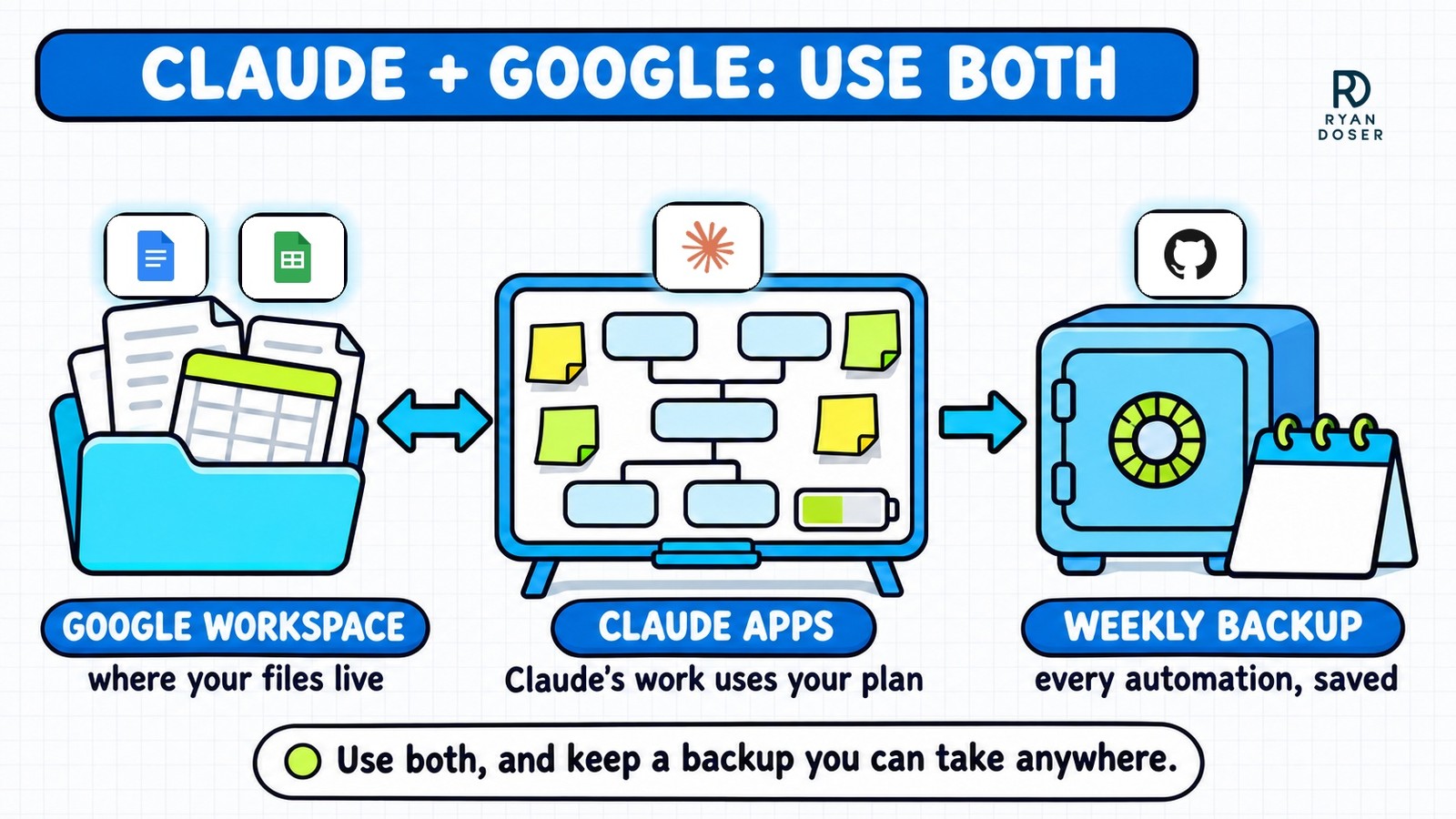
My answer to Claude vs Google Workspace is to use both: try Claude's new Whiteboards, Sheets and Docs, keep your files in Google, and back up anything Claude runs for you. Aaron Makelky and I both pay for Claude every month, and neither of us knows anyone canceling Google for these apps.
Watch Aaron and Me Weigh Claude vs Google Workspace
Claude vs Google Workspace is a choice between the apps Anthropic now builds into a Claude plan, like Whiteboards, Sheets and Docs, and Google's own Docs, Sheets, Slides and Drive. Some people on YouTube are calling the new bundle "Claude 2.0," so here's the full episode, then my verdict.
If you want the Claude setup behind my own marketing work, my Claude Skills Stack holds the skill files I run every day.
My Claude vs Google Workspace Verdict: Use Both
Telling someone who is all in on Google or Microsoft to delete everything and move into Claude would be doing them a disservice. As I said on the episode, "the opportunity cost there just doesn't make sense."
Aaron asked who is canceling Microsoft or Google for these apps, and neither of us could name anyone. His take: "you'd be stupid to, because you're just gonna get locked deeper in their ecosystem."
My answer was simpler: "It's a matter of using both." I think it's foolish for Anthropic to expect people to drop a $20 Gmail plan, a team plan or a Microsoft plan and hop over.
Anthropic is also building in the other direction. Its Claude for Google Workspace add-on puts a Claude sidebar inside Google Docs, Sheets and Slides, in beta on the Pro, Max, Ultra, Team and Enterprise plans.
The answer shifts a little if you're starting from scratch with no Google or Microsoft habits to unwind. Enterprise teams have another reason to wait, since Aaron's point is that big teams have watched plenty of tools get discontinued: "Google kills apps more than most companies release new apps."
What Claude Whiteboards, Sheets and Docs Actually Do
Here's what Claude is asking you to move into. Anthropic launched Claude Whiteboards and Claude Sheets in beta on November 10, 2026, and turned its dashboards into Claude Data, according to its launch post.
The same week, Anthropic also announced Claude Meetings, which joins Google Meet calls.
Claude Docs, Slides and Design are on every plan, while Whiteboards and Sheets need Pro or higher. These are the pieces that overlap with Google's apps and with tools like Miro.
Aaron demoed a whiteboard on the episode. In FigJam he'd @mention a coworker, but here you leave a comment for your Claude agent, and Claude moves boxes, finds logos or explains a section.
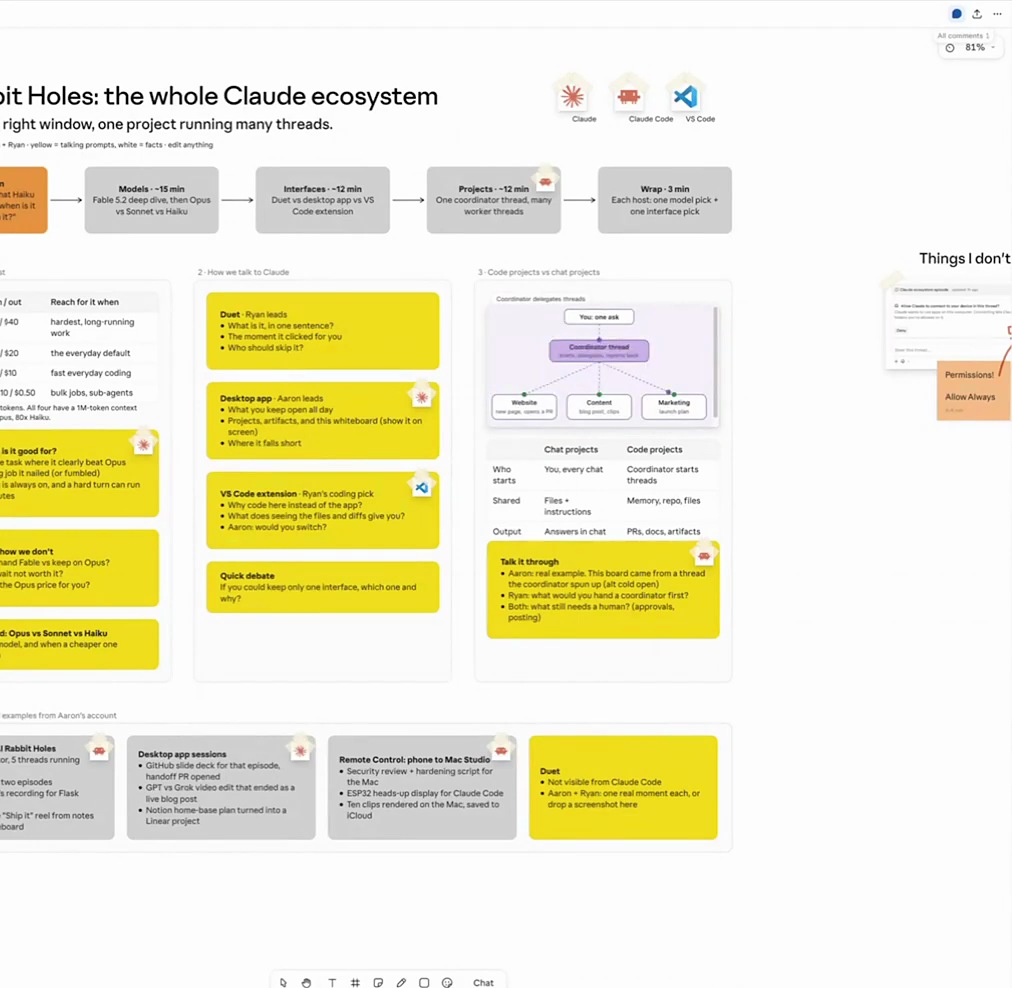
Aaron's theory on why Anthropic is doing this: two years ago, the labs said you could "vibe code your own internal tooling" and replace your subscriptions, and in his telling, nobody got rid of Microsoft, Google or Notion. So the labs are building those tools into your subscription instead.
One correction, because Aaron got this part wrong on the recording. He said "you can't take your whiteboard out of Claude," but Anthropic's launch post says Claude can turn a board into a doc or deck, or bring it into Lucid, Miro or Vani by Zoho.
Docs export to Word, PDF, Markdown and Google Docs, per Anthropic's artifacts help article, and the launch post says Sheets export as .xlsx or CSV.
For anyone weighing Claude vs Google Workspace, that means your files are more portable than the episode suggests. The harder thing to move is the automations Claude runs for you, which I cover below.
Claude vs Google Workspace: Usage Limits, Seats and Lock-In
The bigger difference is what your subscription buys. Google Workspace and tools like Miro charge per seat, while a Claude plan caps how much work Claude can do, and Anthropic's help pages for Whiteboards and Sheets say using them counts toward your plan's usage limits.
As I put it on the episode, every time Claude takes an action or makes an edit, "it's sucking your usage behind the scenes." Most SaaS, I think, is pretty much unlimited once you pay the monthly subscription.
Aaron put it in terms of his own week of hitting limits on Fable 5.2, Anthropic's newest public model. If he came back to the whiteboard to leave a comment while rate-limited, his Claude agent couldn't do anything with it.
For comparison, Miro's Business plan listed $20 per member a month, billed yearly, on its pricing page on November 17.
Aaron's second point is an irony. The AI labs push every app to ship an MCP connector (the plug-in that lets an AI tool work inside another app) or an API, yet he predicts Claude will never put one in its own whiteboard.
Figma and Miro both run official MCP servers today, and Anthropic's launch post doesn't mention one for Whiteboards or Sheets. That matters to me, because I'm not going to touch software that doesn't have an MCP or an API.
So use Claude's whiteboard to think and draft, and keep the files that matter somewhere every tool can reach. It's the same AI-friendly question from my build vs buy software breakdown: can your agent actually use the tool?
How I Back Up Every Claude Automation
Whichever way you land on Claude vs Google Workspace, this is the move from the episode worth copying. When we recorded, I had 25 automations running in Claude Duet, Anthropic's assistant app that runs scheduled tasks in the cloud, and every one of them is backed up to a private GitHub repo.
Here's why, in my words from the episode: "What if the rate limits become unaffordable in a $200 a month plan? Or what if the subsidized plans go away altogether?"
I don't want to be stuck rebuilding 25 automations from scratch. With the backup, I have the step-by-step details to rebuild them in OpenAI, n8n, Make or another platform with scheduled actions.
On the episode I described it as a Monday job. Since recording, I've moved it to a nightly backup that follows a short written spec, and here's what it saves:
- Every scheduled task's timing, what it does and its full instructions, with passwords, tokens, emails and account IDs stripped out
- Each chat's messages from that day, one file per chat
- Duet's memory for the main chat and for each channel
- Open tasks, plus a daily log of what got done, what went well, what broke and what it learned
One quirk: Duet's scheduled tasks can't reach GitHub on their own. So the nightly task posts a short marker in the main chat, and Duet hands the backup to a session that has the repo.
To copy it, create an empty private repo first, then ask Duet for a daily backup of every chat, scheduled task, open task and memory note into it, plus a daily log, with passwords, tokens and account IDs stripped out.
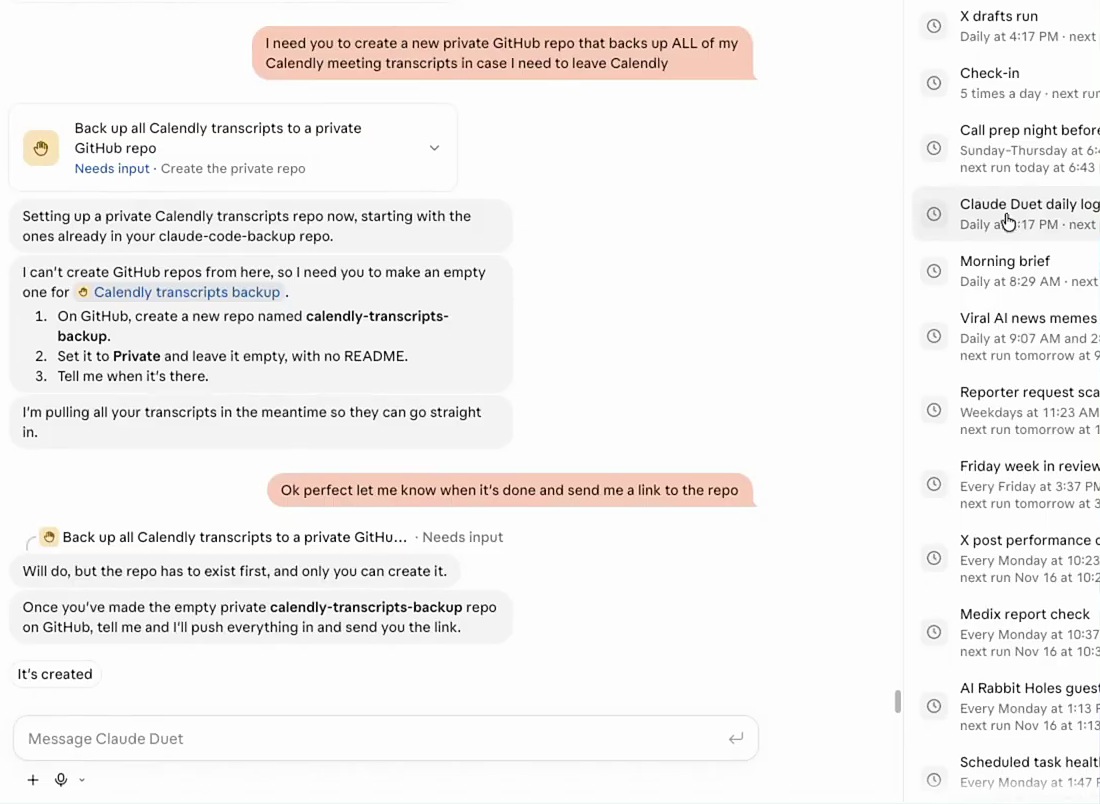
The same screen shows a second example of the habit, this time for meeting transcripts. I typed this into Duet, and you can adapt it for other apps you depend on:
I need you to create a new private GitHub repo that backs up ALL of my Calendly meeting transcripts in case I need to leave CalendlyDuet can't create the GitHub repo itself, so it asked me to make an empty private repo first. Now a Friday task uses the same marker handoff to copy new Calendly transcripts into a private Calendly backup repo each week.
If GitHub is new to you, start with how to use GitHub as a non-coder.
Is Claude Pro Worth It for Whiteboards, Sheets and Duet?
I pay for the $200 Claude Ultra plan, and I don't think the $20 Pro plan is worth it for these apps. As I said on the episode, you're "not going to get any usage out of it" if you plan on going full throttle and using all of its capabilities.
Pro unlocks Whiteboards and Sheets (both still in beta) and makes you eligible for Duet, a US-only research preview with a waitlist. At $20, I think OpenAI has the best plan right now.
| Claude plan | Price (Nov 17, 2026) | Usage vs Pro |
|---|---|---|
| Pro | $20/mo, or $17/mo billed yearly | 1x |
| Max | $100/mo | 5x, every 5 hours and every week |
| Ultra | $200/mo | 10x weekly, no 5-hour limit for verified accounts |
For $200 a month, Ultra is "untouchable right now" for me, and I use it every single day. Aaron is on the $100 Max plan and tells people to get it for heavy work, and to move up to $200 for a month if they keep hitting limits.
Duet is the clearest case for paying more, and I wouldn't bother with it on $20, as I explain in my best AI personal assistants breakdown. Plans change often, so check Claude's pricing page before you weigh Claude vs Google Workspace on cost.
Use Claude Now, Keep an Exit Ready
Aaron calls this a honeymoon period with Claude, and he expects it to change. If you're asking whether we'll get rug pulled, I think that's the wrong question: "It's when we get rug pulled."
So settle Claude vs Google Workspace by using each for what it does best. Keep your files where you can take them, and back up every automation before you need to.
Claude vs Google Workspace FAQs
Will Claude replace Google Workspace?
Not for most people yet, in my view. Claude Whiteboards and Sheets are still in beta, and Aaron Makelky and I don't know anyone canceling Google for them. Paid Claude plans also include a beta Claude for Google Workspace add-on that runs inside Docs, Sheets and Slides. The practical setup is to use both: keep your files in Google, and use Claude for drafting, building and automations you back up yourself.
Can Claude edit Google Docs?
Yes. The Claude for Google Workspace add-on opens a Claude sidebar inside Google Docs, Sheets and Slides, in beta on the Pro, Max, Ultra, Team and Enterprise plans, per Anthropic's help center. That's separate from Claude Docs, Anthropic's own document app, which exports to Word, PDF, Markdown and Google Docs when you want the work back in Google.
Is Claude Pro worth it?
For Claude's new apps and Duet, I don't think so. Pro covers Whiteboards and Sheets and makes you eligible for Duet, a US-only research preview with a waitlist, but Claude's work inside them draws on the same plan usage, and $20 runs out fast if you go full throttle. Pro cost $20 a month, or $17 a month billed yearly, as of November 17, 2026. At that price, I think OpenAI's $20 plan is the better buy right now.
Is Claude Max worth it?
For heavy work, yes. Aaron Makelky pays $100 for Max, which gives 5x Pro's usage, and recommends it for jobs like a website codebase. I pay $200 for Ultra, which gives 10x Pro's weekly usage and no 5-hour limit on verified accounts, and I use it every day. Those are November 17, 2026 prices, so check before you upgrade.