
Is ChatGPT Pro Worth It for Marketers After DevDay?
Is ChatGPT Pro worth it after OpenAI DevDay? As your only plan, not anymore: Claude Max is the better $200 for knowledge work, and the entry Pro tier still earns a spot as a second plan.
Update, October 30, 2026: OpenAI reversed the Pro 200 cut this post was built around. Its Pro help page now says "The reduction announced in our September 29 email is canceled."
Pro 200 subscribers who had the lower Work and Codex allowance got it doubled to match the old one, and their weekly GPT-6 Pro message limit went back up too. Pro 100 and Pro 500 now include twice their previous Work and Codex allowance. Every Pro tier also comes with monthly API credits: $100 on Pro 100, $200 on Pro 200 and $500 on Pro 500.
The recap below is what Aaron and I said on October 1, while the cut was still in place.
Is ChatGPT Pro Worth It? Our DevDay Recap
Aaron and I recorded this episode of AI Rabbit Holes on October 1, two days after OpenAI's DevDay keynote.
Aaron spent at least nine months telling people the $200 ChatGPT Pro plan was the best value in AI. While he watched the DevDay announcements, he signed up for Claude Max.
If you want the files that make switching between vendors a one-afternoon job, my Claude Code Skills Stack is the same set of skills I run every day.
What DevDay Changed on the ChatGPT Pro Plans
On September 29, 2026, OpenAI changed what the money buys, and the price tags barely moved.
- ChatGPT Pro is now three plans: Pro 100 at $100, Pro 200 at $200 and a new Pro 500 at $500 a month. Plus stays at $20.
- New Pro 200 subscriptions got "a lower usage allowance than previously offered," per OpenAI's Pro help page at the time. The price stayed at $200.
- Existing Pro 200 subscribers were set to keep the old allowance through October 29, 2026, then move to the lower one. OpenAI canceled that move on October 29.
- Pro 500 got the highest allowance, listed at launch as 25 times what Plus includes, plus Ultrafast mode, according to OpenAI's DevDay recap.
I pulled up the upgrade card in my own account while we recorded. Look at what changes between the three tiers.
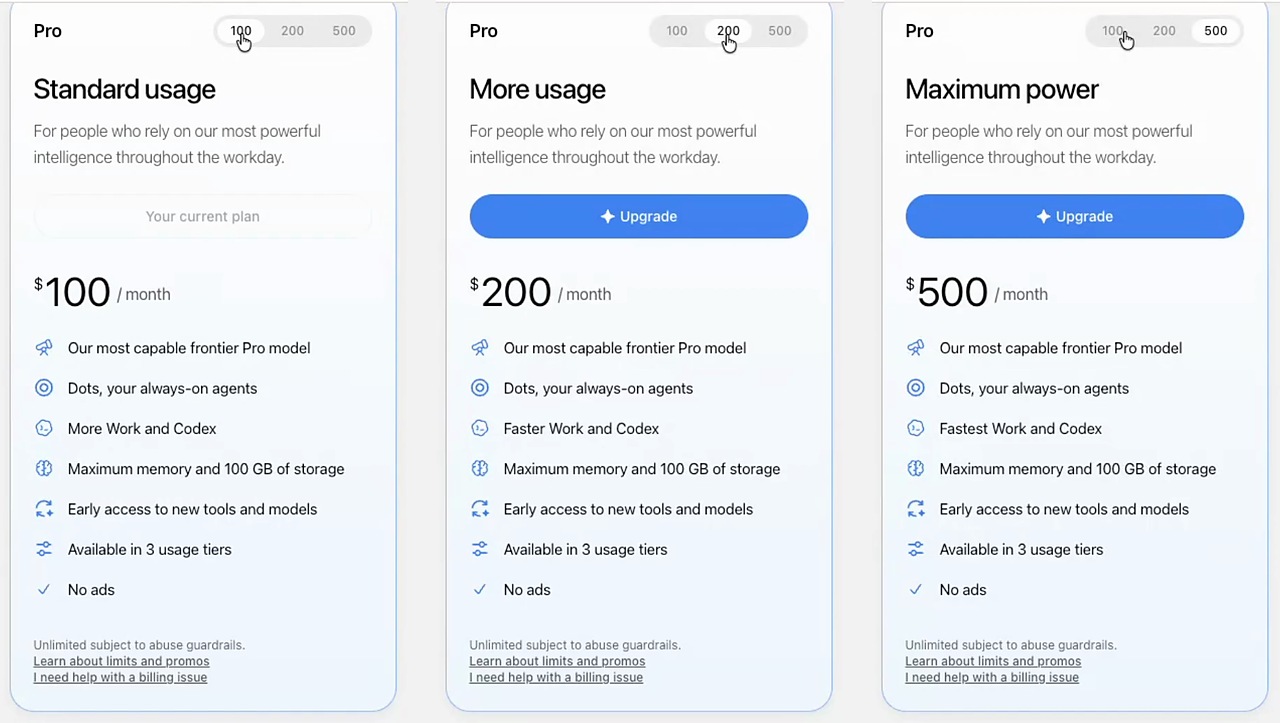
The headings change from "Standard usage" to "More usage" to "Maximum power," and one feature line moves from "More" to "Faster" to "Fastest Work and Codex." Every other feature line matches, down to the dots agent and the 100 GB of storage.
Is ChatGPT Pro worth it at $200, then? The card can't tell you, because none of the three prints a usage number.
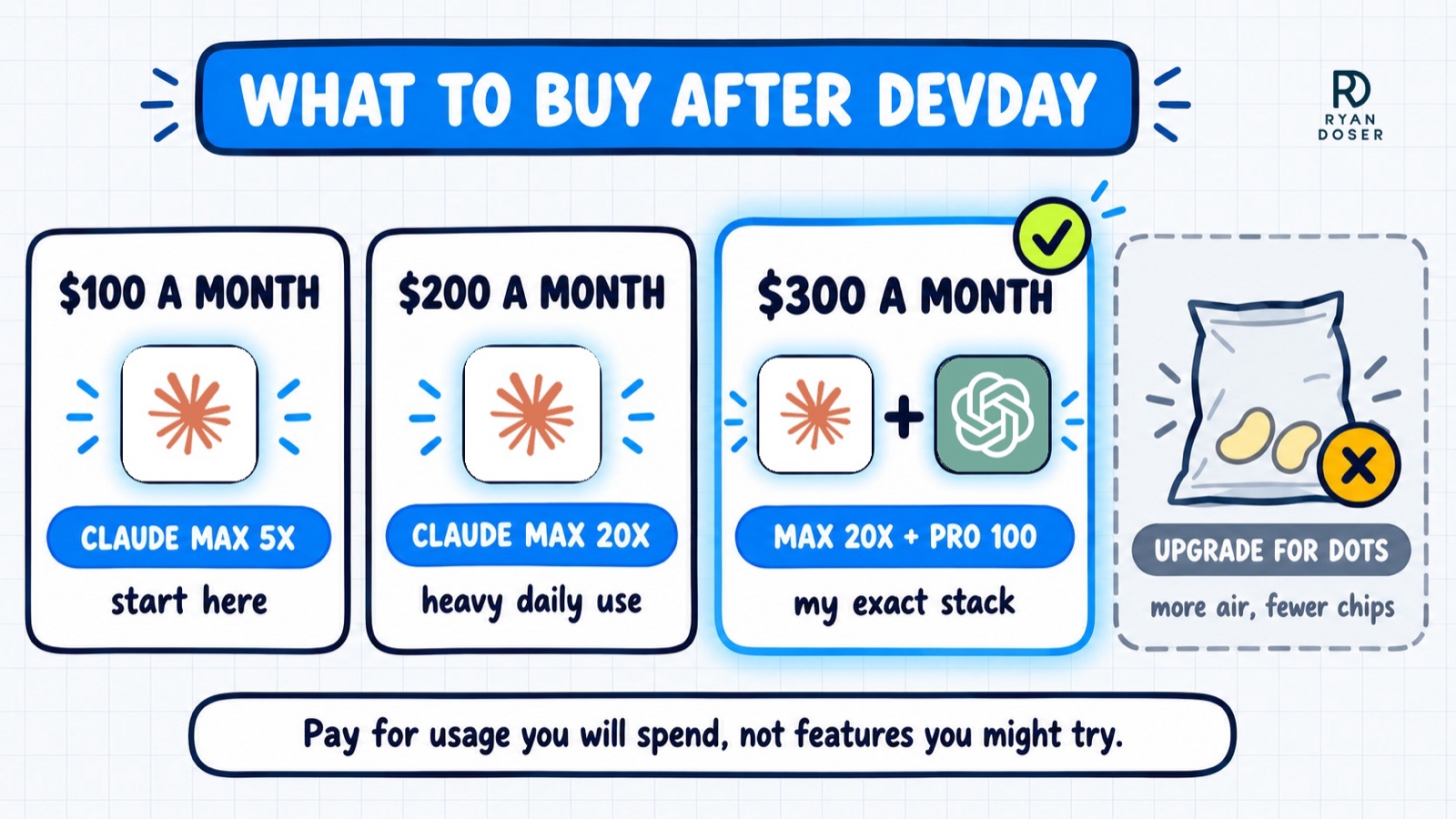
Aaron put it best when I compared the change to a bag of chips: "There's just more air and fewer chips." Same bag, same price, less inside, until OpenAI walked it back on October 29.
That line later became a test case, when my editor and my AI intro skill each turned it into a visual. Here is a side-by-side of the two edits.
One correction to what we said on the recording
On camera, Aaron said the $200 plan now gets "a quarter of the use" it used to. OpenAI later said the lower Work and Codex allowance "doubled to match" the higher one, which puts it at half, not a quarter. The cut is now canceled.
What we do know: before DevDay, OpenAI's own help page listed the $200 plan at 20 times the Plus allowance. Today it still lists no Plus multiple, only that Pro 200 includes more usage than Pro 100.
Aaron's bigger point was that "the only reason to upgrade to five hundred is to get back to the rate limits that your two hundred plan used to be." That was Aaron's read at the time. OpenAI never published a Plus multiple for the reduced Pro 200, and with the cut canceled, Pro 200's Work and Codex allowance and weekly GPT-6 Pro message limit now match the higher levels, so the argument no longer applies.
My read at the time was that OpenAI was pulling subscription value closer to what the same usage costs on the API. Aaron's version: OpenAI was the best value in AI "until this week."
Who Pro 500 is actually for
Almost nobody, as a daily plan. Its headline feature is Ultrafast, which OpenAI says runs up to 8x faster in Codex.
The fine print matters more. OpenAI's help page says Ultrafast uses your included allowance at 8 times the normal rate.
Real work also waits on tool calls, file reads and web fetches, and none of that gets faster. I'd save Ultrafast for a real deadline and leave it off the rest of the time.
Aaron also warned about drain. He says he saw people burn "the entire $500 a month plan limit" in about 30 minutes on Astra, a model he calls very token hungry.
His explanation is that Pro plans have no five-hour limit, which OpenAI's own pricing docs confirm, so nothing pauses a heavy session partway through. Claude Max resets a session limit every five hours.
ChatGPT Dots Is Not a Reason to Upgrade
Is ChatGPT Pro worth it just to get a dot? Aaron tested one so you don't have to.
"You need a hundred dollar or higher plan to get access to one dot, do not subscribe to that just for a dot if you were having FOMO from that. I'm telling you right now, it's not worth it."
A dot is an always-on agent inside ChatGPT, powered by GPT-6 Astra, with its own computer in the cloud. OpenAI's launch post says your first dot is included in Pro or Business Premium, with more dots coming "in the future."
Mine is named Bodie, and his memory lives outside ChatGPT. He reads a private GitHub repo of almost 4,200 files and writes a daily log back to it, which I show in my post on using GitHub as a non-coder.
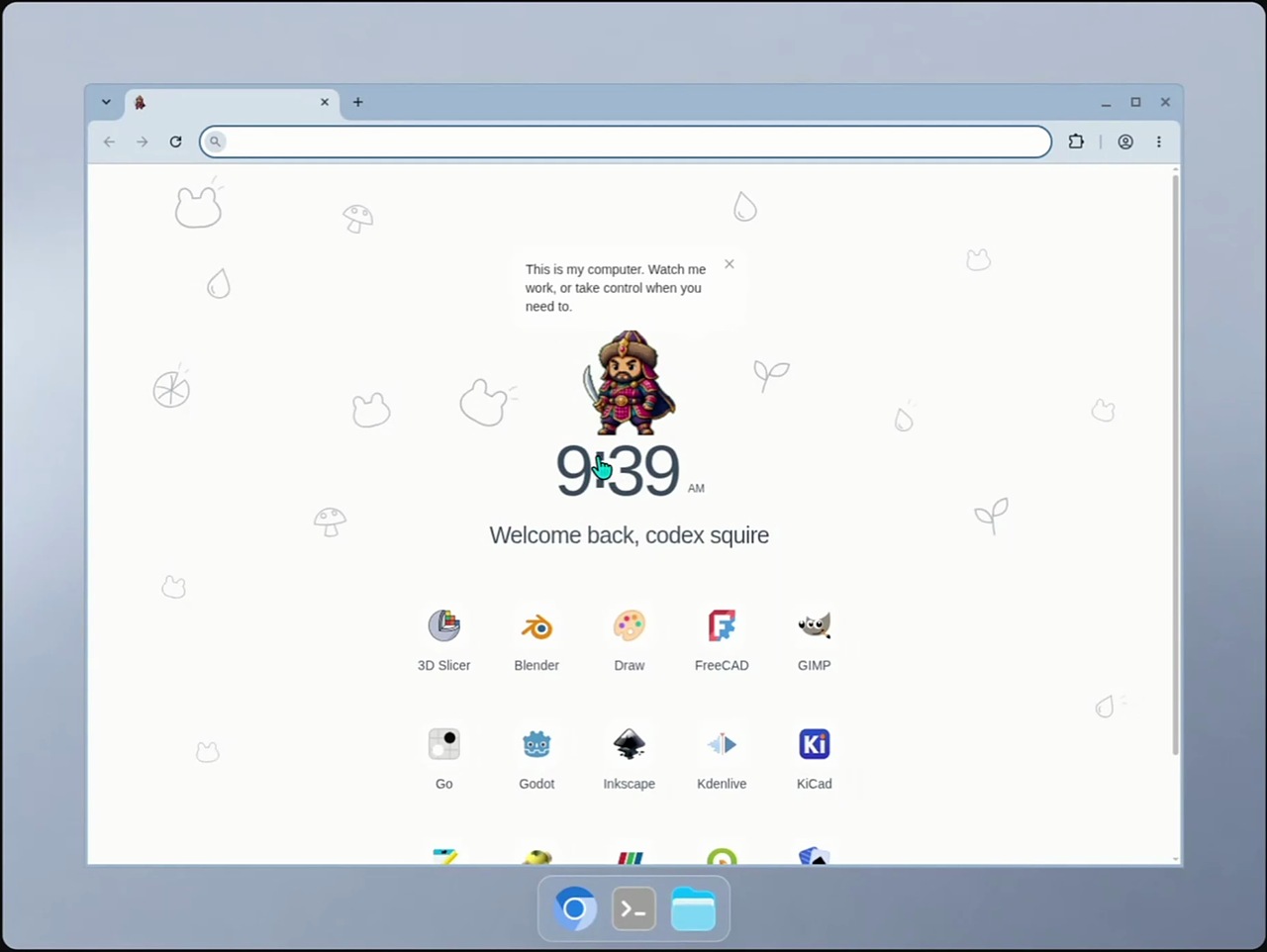
He set his up, tried one of everything, called it from the ChatGPT app and then stopped using it. His summary: "rough around the edges and kind of janky."
Aaron called the cloud computer its biggest unique feature. He explained that you can take over its screen and type a password yourself for a job like booking a flight.
Even so, his bigger complaint is that it does nothing you couldn't already do in Codex. It's a new form factor around the same tools.
I haven't tested a dot myself yet. From the outside, it looks like a glorified Codex session that runs 24/7.
The dots details buyers miss
- Plus does not include dots, and Pro users in the EEA, Switzerland and the UK can't get one at launch.
- OpenAI's release notes said dots usage wouldn't count toward eligible Pro plan allowances for the first month after launch, with usage terms to follow after that.
- Tasks your dot starts in Codex or ChatGPT Work already draw down your limits today.
- The "call your dot" feature is a phone button inside the ChatGPT app. Your dot cannot call you at launch.
Aaron's read on that free first month is what you'd expect: "Here's the free sample, get you hooked, and now you're gonna pay next month."
Dots is also plural, but you can only make one, while Grok Bot already lets Aaron run separate bots for separate jobs. I still expect a polished version to win over people who want official integrations eventually, and I compare it with Grok Bot, Muse and Duet in my four-way personal agent breakdown.
Aaron dug into where a dot's proactive nudges come from. Per Aaron, it runs on a prompt called Heartbeat Dreamer, where a parent agent works with a child "dreamer" agent that scans your calendar, email and projects.
He published that prompt with a step-by-step guide to building your own dot in Claude. You can try the same setup on a Claude plan before paying $100 a month for ChatGPT Pro.
What about ChatGPT Space?
DevDay also launched ChatGPT Space, a shared workspace where teams collaborate with AI, on Pro, Business and Enterprise plans. To me, Space is an ecosystem play aimed at Google Drive and Notion, while Anthropic is betting on the better model.
Before you move your team's files in, Aaron asks whether you trust OpenAI to support it long term. OpenAI is already retiring custom GPTs on December 11, 2026 and pointing builders to plugins.
My advice from the episode applies here too: "just create skills, use an IDE and call it a day." Space alone doesn't justify a bigger plan, and skill files you own still work after a vendor retires a product.
Why Claude Max Is the Better $200 Right Now
Two weeks ago I published a ChatGPT Pro vs Claude Max comparison that leaned toward OpenAI on plan math. At the time, Aaron had no Claude subscription at all.
Here is what I said this week, word for word: "A $200 a month Claude Max plan is far better than a $200 a month ChatGPT Pro plan now, which is a complete 180 of what I was telling people a week or two ago."
Is ChatGPT Pro worth it as your only plan? On the episode we said no, for two reasons.
OpenAI cut what the $200 buys, and Anthropic shipped two models that are worth the usage. OpenAI canceled the cut on October 29, so the case for Claude Max now rests on the models.
My take on the episode was that Opus 5.5 is the best AI model right now "for most people," with the hedge that I meant knowledge work, not coding. Claude Sonnet 5.5 shipped on September 28 and is now my workhorse.
Since signing up, Aaron has used Opus for planning and design and Sonnet for day-to-day tasks. His first reaction to Sonnet was "it's really fast."
He also said Opus "blows the OpenAI models out of the water" on anything visual, from landing pages to website animations.
Three friends texted him that week asking for the one-sentence answer on all the new releases. His answer was "Don't get an OpenAI sub."
Then, to me: "I haven't said that since at least February of 2026 to anybody."
Claude Max costs $100 for 5x or $200 for 20x the Claude Pro plan's per-session allowance. Max now includes $100 or $200 a month in API credits for building on the Claude Platform, the same kind of bonus OpenAI now bundles with Pro.
I don't expect Max pricing to stay put. If a $500 Claude plan and a smaller $200 one show up in a few months, I won't be surprised, which is why my advice on the episode was to get Claude Max now and use as much of it as you can.
One way I stretch my plan is a markdown file built from Opus 5.5's best outputs plus Anthropic's own documentation. A rule in my workspace tells Sonnet to read it first, so more daily work runs on Sonnet and my Opus usage lasts longer.
Why I'm Keeping ChatGPT Pro at the Entry Tier
None of this means I'm canceling ChatGPT. I'm on Pro 100, and that is where I'm staying.
Is ChatGPT Pro worth it as a second plan? For me, yes, because every model in my setup has a job written down in the AGENTS.md file that runs my workspace.
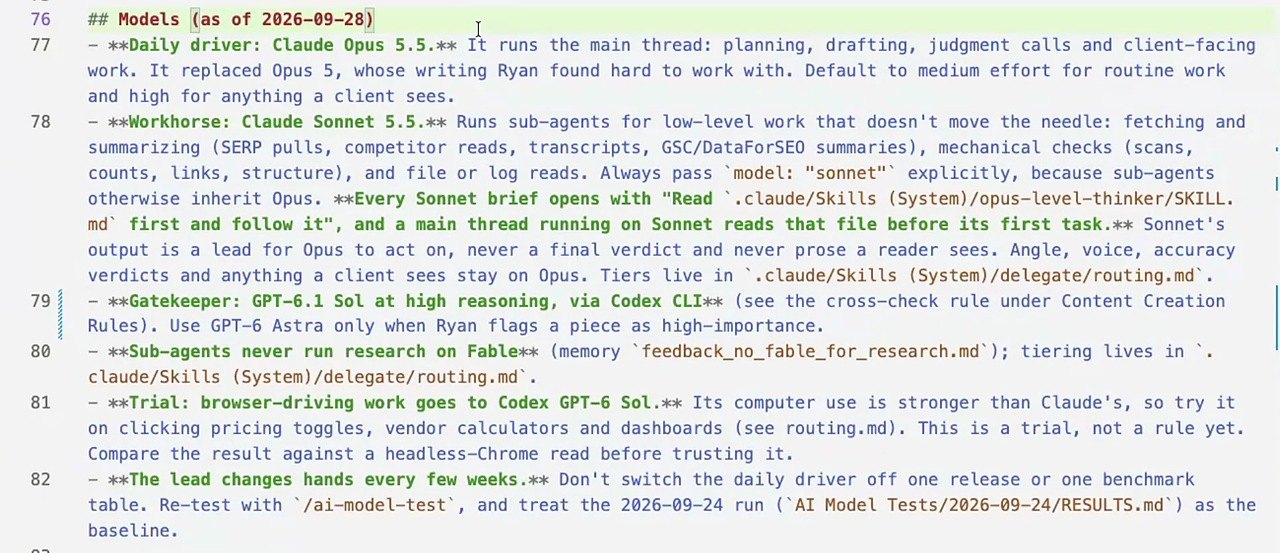
- Daily driver: Claude Opus 5.5, for planning, drafting and anything a client sees.
- Workhorse: Claude Sonnet 5.5, for SERP pulls, competitor reads, web fetches and data summaries.
- Gatekeeper: GPT-6.1 Sol at high reasoning, run through the Codex CLI, which red-teams whatever a Claude model produces.
Image generation is the other job that keeps me on OpenAI. Neither job needs more than the entry Pro tier.
Red-teaming goes to OpenAI because a critic from another model family catches what a Claude reviewer misses. OpenAI's models are still strong enough for the job, and Sol's landing page in my model test surprised me.
Aaron's take is that Sol is the model the DevDay limits pushed you toward. OpenAI prices it at one-fifth of Astra's token rates.
In his first two days with it, Sol made those limits go much further, at the cost of speed.
Aaron clocked it at 20 to 30 tokens per second, which he puts at half his usual pace or slower. His rule of thumb from his own workload: past four or five Codex projects at a time, Pro 100 ran out on anything but Sol. That was before OpenAI doubled the Pro 100 Work and Codex allowance on October 29.
I walk through the full routing logic in which Claude model to use for which job.
ChatGPT Pro still has things Claude doesn't. Aaron likes OpenAI's plugins, voice mode and image model, and he finds Anthropic's desktop and phone apps half-baked next to them.
His tiebreaker is the one I agree with: "If I don't get a good model at usable rate limits, what good are all those extra add-ons?"
Buy the Plan You Will Actually Use Up
So, is ChatGPT Pro worth it now? For most marketers buying one AI subscription, no.
For writing, research and client work, my bet is that Claude Max gets you more of a better model for the same $200, at least until Anthropic reprices it.
Next to Claude Max, the entry Pro tier still earns its spot in my setup for red-teaming and images. Upgrading for dots or Ultrafast is the move I'd skip.
Is ChatGPT Pro Worth It FAQs
Is ChatGPT Pro 500 worth it?
For most people, no. Pro 500 costs $500 a month and has the highest allowance of the three Pro plans, plus Ultrafast mode and $500 a month in API credits.
Ultrafast uses your included allowance at 8 times the normal rate, and real tasks still wait on tool calls, so the speed you feel is smaller than the headline. It makes sense only if Pro 200 limits block paid work every week.
Do you need ChatGPT Pro to use dots?
Yes, or Business Premium, and Enterprise workspaces can switch on a beta. Plus does not include dots. Your first dot comes with Pro, which starts at $100 a month.
Dots usage didn't count toward your plan allowance for the first month after launch, and tasks a dot starts in Codex or ChatGPT Work still draw down your limits. Pro users in the EEA, Switzerland and the UK can't get dots at launch.
Did OpenAI cut ChatGPT Pro 200 usage?
It did, then reversed it. New Pro 200 subscriptions got a lower allowance from September 29, and existing subscribers were due to move to it after October 29. On October 29 OpenAI canceled the reduction.
Subscribers on the lower Work and Codex allowance had it doubled to match the old one, and the lower weekly GPT-6 Pro message limit now matches the higher one. New Pro 200 subscriptions get the higher Work and Codex allowance at the same $200.
OpenAI has not published a Plus multiplier for the reduced plan. Its note that the lower Work and Codex allowance "doubled to match" the higher one means that allowance was half the old one, so Aaron's on-air figure of "a quarter of the use" does not hold for Work and Codex.
Is Claude Max better value than ChatGPT Pro right now?
For knowledge work, that is where Ryan Doser and Aaron Makelky both landed after DevDay. Claude Max costs $100 for 5x or $200 for 20x the Claude Pro per-session allowance, with Opus 5.5 and Sonnet 5.5 included. If your work depends on OpenAI's image model or plugins, keep the entry ChatGPT Pro tier alongside it, which is what Ryan does.