
How to Avoid AI Slop Now That It's Everywhere
The fastest lesson in how to avoid AI slop is one lazy prompt: Claude Opus 5.5 and GPT-6.1 Sol both turned it into a generic "Beginner's Guide" that passed my banned-word list. Aaron Makelky and I spent an AI Rabbit Holes episode on what fixes that, and a longer word list isn't it.
How to Avoid AI Slop in 5 Steps
AI slop is low-effort content published with no context, editing or point of view behind it. What separates AI content from AI slop is what you feed the model and what checks the draft before it ships. Here's the full episode, then the five steps it lands on.
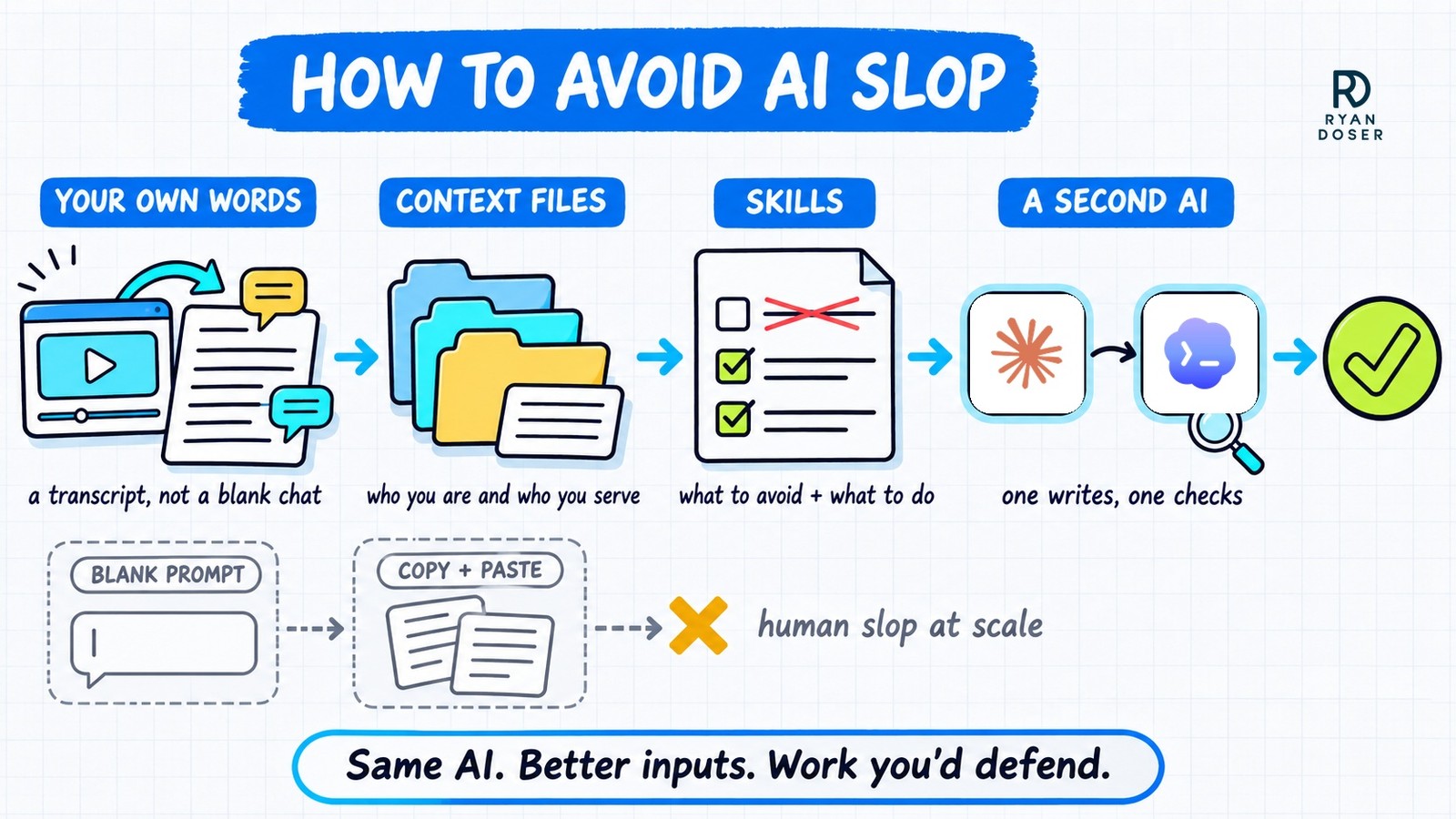
- Start from your own words: record a podcast or long-form video and give the AI its transcript instead of a blank chat.
- Give the AI context files that say who you are, who you serve, what you sell and how you sound.
- Write one skill per content type that pulls two levers: the patterns to avoid and examples of what good looks like.
- Run every draft past a second AI model and a ship-or-no-ship check before anything publishes.
- Add each new AI tell you spot to your anti-slop skill, and change a skill when traffic or clicks say its format isn't working.
If you want working files to start from, my Claude Code Skills Stack is the pack of skill files I build with every day.
What Is AI Slop? Human Slop at Scale
Google was fighting slop more than a decade before ChatGPT existed. That history explains how to avoid AI slop now, because the problem was always quality.
My definition has two parts. First, AI slop is human slop at scale: the models learned from human writing, and mediocre human writing never went away.
Second, it's what happens when someone types "write me a blog post" into a blank ChatGPT or Claude chat, then copies and pastes the output with no skills or context behind it.
Google's February 2011 ranking update went after low-quality sites, including ones that "copy content from other websites," and Google said it noticeably affected 11.8% of queries.
In its 2023 guidance on AI-generated content, Google recalled concerns from "about 10 years ago" over "a rise in mass-produced yet human-generated content." The same post says "appropriate use of AI or automation is not against our guidelines."
Aaron's analogy is the clearest I've heard. Human slop was a BB gun, manual and slow, and AI handed the same people a chain gun, which is why he says "you can't win on volume anymore."
The word is mainstream now, too. Merriam-Webster named "slop" its 2025 Word of the Year.
In my opinion, models like Opus 5.5 and GPT-6.1 Sol already beat a mediocre copywriter, designer or editor. So the bar for what you publish is higher than it has ever been.
Why a Banned-Word List Won't Stop AI Slop
Most advice on how to avoid AI slop starts and ends with words to ban. A simple test for this episode's slides shows why that's only the floor.
The same one-line prompt, "Write me a blog post about how to use GitHub.", went to Claude Opus 5.5 and GPT-6.1 Sol through the API with no system prompt, no context and no skills.
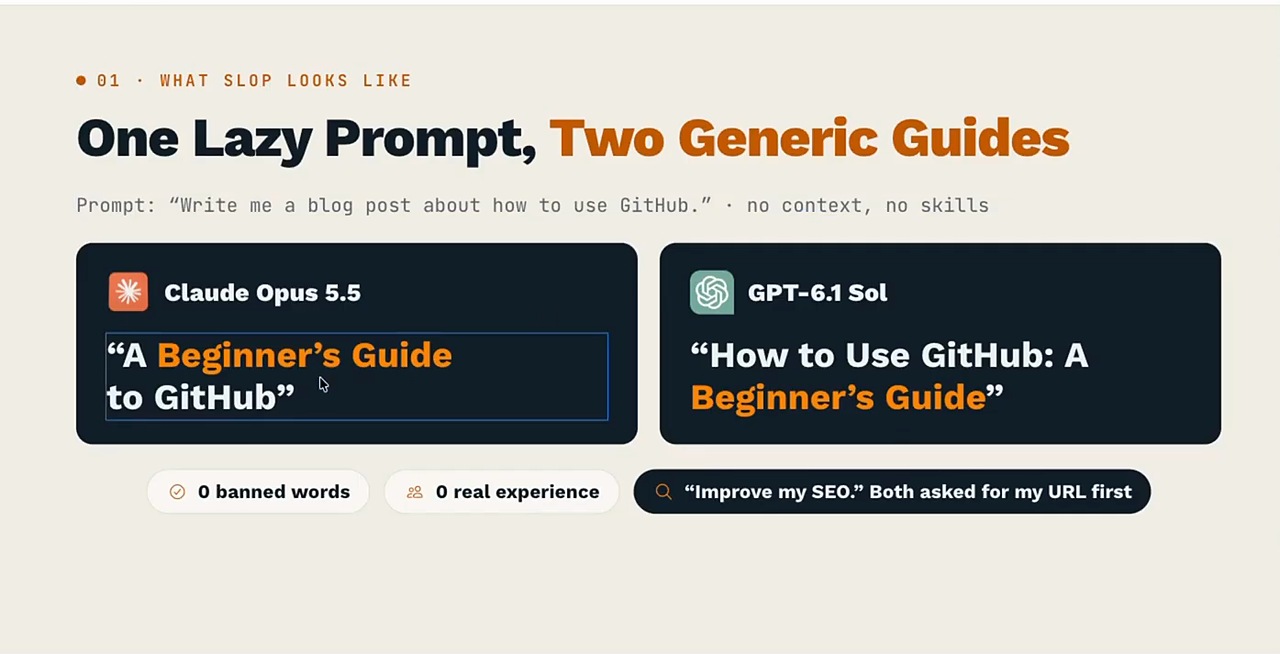
Both drafts assumed a developer audience, because the prompt never said who the post was for. Both used zero words from my 39-word banned list, and neither had a real example, test or opinion a reader couldn't find anywhere else.
A second prompt, "Improve my SEO.", got the same first move from both models: share your website URL, along with a generic checklist. The models know they need context, and slop happens when people skip that question and use the checklist as-is.
Aaron made the same point about source material on the episode. If the original piece was AI-generated, he warned, you're "chopping up slop into different shapes."
Start From Your Own Words to Avoid AI Slop
If your AI drafts sound like everyone else's, check what they started from. Step one in how to avoid AI slop, and the number one thing people miss as I said on the episode, is a long-form video or podcast as the foundation.
A long-form podcast episode hands the AI a transcript full of original thoughts, phrased the way you actually talk.
Every video I publish becomes a blog post, a promo email and social posts through one slash command. Running it is low effort now, but refining it took me close to a year.
Our Best Free GitHub Repos for Non-Coders episode was the starting point for my 10 best GitHub repos for marketers post, with the video embedded, an on-brand diagram, screenshots and internal links.
Five of the post's 10 picks are repos I use myself. Aaron's take is that first-hand picks like those "are not the same ones a Google search or Claude would pick," and that's the reason to start from a human source.
He also called the transcript the most underused output of a long-form video, and clipping the most overused. His tip: a strong idea from a podcast often works better re-recorded than clipped.
Repurposing is where slop shows up fastest, which is why I keep repurposed drafts in my own voice from the first pass.
Build an Anti-Slop Skill With Two Levers
Step three in how to avoid AI slop is the one you can copy today. My anti-slop skill is a Claude skill, a markdown file that tells the AI what never to do.
It flags overused AI words and phrases, the "not this, but that" contrast, em dashes and emoji overload. When new models show new habits, I add them.
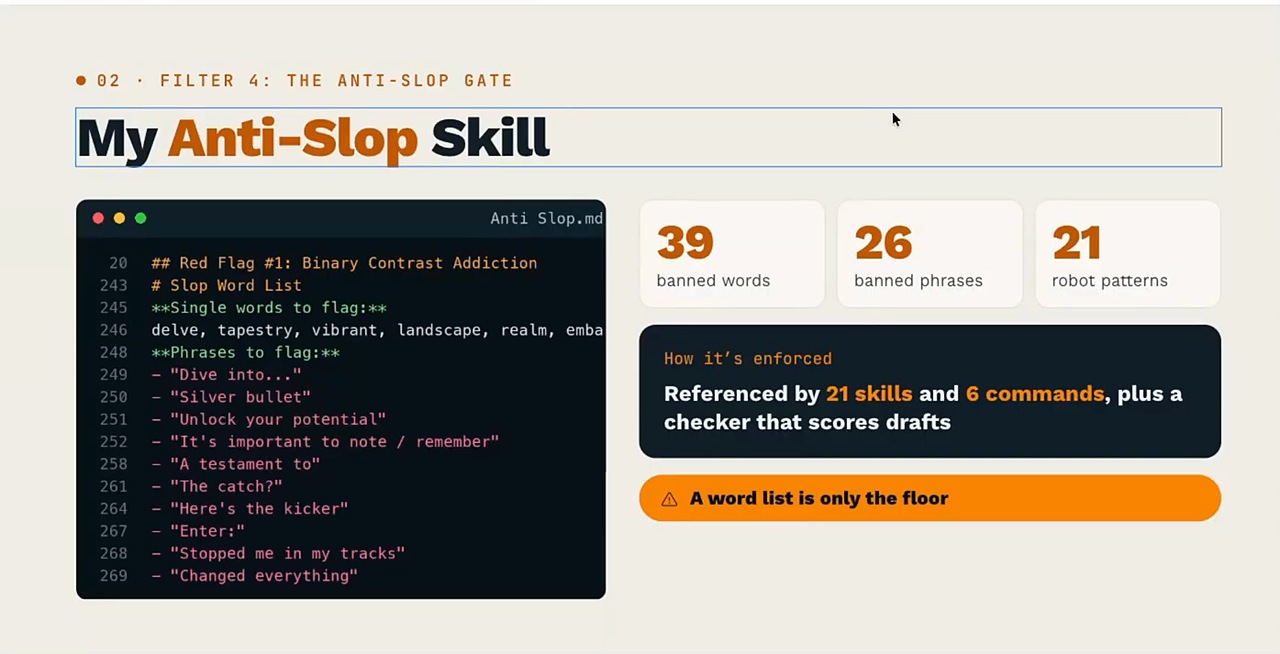
A word list still kills the obvious tells, so start there. You can grab a free version of my Anti-Slop skill.
Keep it current. Aaron's habit: when a phrase in anyone's writing "grinds my gears," he pastes it to his agent and says, "Put this in my anti-slop skill."
His bigger point is that a well-built Claude skill pulls two levers. One is guardrails, what not to do, and the other nudges the AI toward how you write, like "I like to use analogies," with examples of your sentence structure and vocabulary.
In my setup, the anti-slop file is the first lever, and my voice file and one writing skill per format carry the second.
That second lever is the one most guides skip. On November 12, the top Google results for "how to avoid AI slop" were mostly lists of patterns to avoid, like Momentic's "34 types of AI slop."
Context files carry the rest. My Brand Foundation Builder skill scrapes a website and social profiles, then writes four or five markdown files, including a brand guide, a customer profile and an offer guide, so drafts start from my brand instead of a blank page.
He also shared his public AI writing audit skill, and he's clear it is "not an AI detector." It tags patterns linked to low-effort AI writing, fixes them and returns a change log, like an editor's red pen.
Gate Every Draft With a Second AI
Nothing I publish ships on the first iteration. Every written output, from blog posts and emails to social posts and YouTube titles, goes through an anti-slop gate and a brand voice gate, then gets a ship or no-ship verdict.
A second model plays gatekeeper. Claude writes, Codex on GPT-6.1 Sol critiques, Claude fixes the valid issues, a critic agent rules ship or not, and I make the final call, a pairing I break down in Claude Code and Codex together.
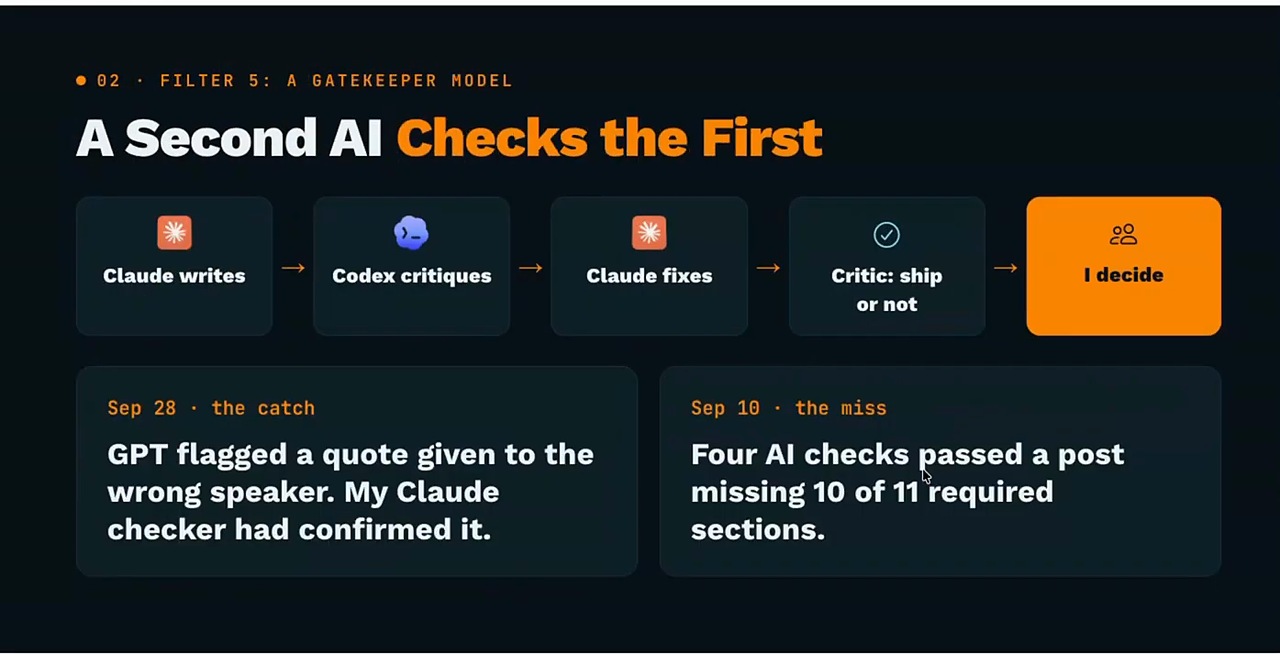
Step four in how to avoid AI slop is a second check, but it isn't magic. On September 10, four AI checks passed a post that was missing 10 of 11 required sections.
Gates judge what's on the page, so a scripted checklist now catches what's missing. Then on September 28, GPT flagged a quote my draft gave to the wrong speaker, after my Claude checker had confirmed it.
Aaron's rule covers the whole loop: if you won't iterate on it, don't waste your time doing it. Use your traffic and click-through numbers to make next week's version better.
Does Google Penalize AI Content?
Google's answer has held since 2023: appropriate use of AI is fine, and spam is spam, however it was made. If you're learning how to avoid AI slop for SEO, that's the line that matters.
Google's spam policies define scaled content abuse as many pages "generated for the primary purpose of manipulating search rankings and not helping users," and the policy applies "no matter how it's created."
I turned those guidelines into an anti-spam skill that sits next to my anti-slop skill, so every draft also gets checked against what Google calls spam.
As I put it during the recording, my content is AI-generated, "but it's not AI generated spam content. Huge difference there."
AI-assisted content isn't locked out of search. On a November 12 check, Google's AI Overview for "blotato review" cited my Blotato review, and my 2025 review video was the first video in that search's video results.
That's one search, not proof of a pattern. Rankings still depend on whether the page helps the person searching.
Avoid AI Slop in Design, Too
Slop shows up in websites and slides as fast as it shows up in writing, and the same rules for how to avoid AI slop apply there. You've seen the landing page that looks like every other AI build.
Impeccable's slop page shows exaggerated examples of the design habits different AI model eras fall into, from 2022 through 2026, like purple gradients, glass panels and neon glow.
Aaron set a hook so his agent calls the Impeccable skill automatically on any design task, and Aaron and I used it on a live build in how to vibe code a website.
He also keeps a design.md, a file of visual rules he uses for landing pages, images and video.
If you aren't a designer, his advice is "just have it ask you," and let the AI interview you about fonts and sites you like.
What Ole Lehmann Adds on AI Slop
This post first covered my conversation with Ole Lehmann, and his take on how to avoid AI slop still holds. His sharpest point: the worst slop starts before AI writes a word, when someone asks the AI what to write about.
Ole also defines slop as content that agrees with everyone, and his fix starts upstream: voice notes captured through the day, so AI handles production while he handles the thinking. Watch my full interview with Ole Lehmann for the slop markers he checks before posting.
Call Out Human Slop When You See It
AI content doesn't equal AI slop, and human slop never went away. When you see slop, call it out, whether a person or a prompt wrote it.
Aaron put it best: "Don't blame the AI tool. Blame the human that's using it."
How to Avoid AI Slop FAQs
What is AI slop?
AI slop is low-effort content published with no context, editing or point of view behind it, whatever tool produced it. My shorthand is human slop at scale: the same mediocre habits people had before generative AI, now produced in seconds. Merriam-Webster named "slop" its 2025 Word of the Year. The fix starts with source material only you have, like a transcript of something you actually said.
Can AI-written content still rank on Google?
It can. Google's 2023 guidance says "appropriate use of AI or automation is not against our guidelines." Its spam policies target scaled content abuse, meaning many pages made mainly to manipulate rankings, however they were created. A post built from real experience and checked before it publishes sits in a different category from mass-produced pages.
What are examples of AI slop?
Common examples include a generic "Beginner's Guide" written from a one-line prompt with no audience in mind, and posts stuffed with em dashes, emoji and the "not this, but that" contrast. In design, it's the landing page with the same purple gradients, glass panels and neon glow as every other AI build. Clips chopped from a weak, AI-generated source are slop too. Most share one gap: no context or point of view from the person publishing.
How do I make AI writing sound human?
Pull both levers in your writing skill: patterns to avoid, plus examples of how you actually write, from sentence structure and vocabulary to favorite analogies. Start drafts from your own words, such as a podcast transcript. Aaron warns that even a transcript-based draft picks up AI writing patterns, so run a second check before anything goes live.